Best Email Verification API in 2026: ZeroBounce, NeverBounce, or One Call on Monid?
An honest structural comparison of ZeroBounce, NeverBounce, and Strale email verification on Monid: credit packs vs one metered per-call endpoint.
Copy this line to your agent to verify an email address before you send.
set up https://monid.ai/SKILL.md and use strale to validate an email address and check its deliverability
Here is the honest version. If you clean million-row lists every week, a dedicated verifier like ZeroBounce or NeverBounce still wins on raw unit price, and you should keep using one. For almost everything else, and especially for an agent that needs to check one address at the moment it finds it, pre-buying a single-purpose credit balance is the wrong shape. A single metered Strale endpoint on Monid does the same syntax, MX, disposable, and deliverability checks, priced per call, on the same wallet that already runs your scraping and enrichment. Monid is a pay-per-call data API marketplace: one integration and one balance reach hundreds of external data endpoints, so email verification stops being a separate vendor account and becomes one line item.
TL;DR
- ZeroBounce and NeverBounce are excellent dedicated verifiers, but both make you pre-commit capital to a credit balance that only buys email checks, and both strand what you do not spend (packs expire, subscription allotments do not fully roll over).
- Strale's
/x402/email-validatecovers RFC 5322 syntax, MX records, 5,361 disposable domains, 35 role-based patterns, free provider detection, and typo suggestion (gmial.com to gmail.com), billed per call at a few cents, with the price shown before you run. - Domain-level deliverability (SPF, DKIM, DMARC, MX, blacklist, 0 to 100 score) and full prospect verification are separate endpoints, so you pay for the depth you ask for and nothing more.
- The structural win is not a lower sticker price, it is no minimum purchase, no expiring credits, and no second vendor, because verification shares one pay-as-you-go wallet with the rest of your data stack.
- Monid ships as an MCP server, so an agent can pick the right verification endpoint per task and run it inline.
How ZeroBounce and NeverBounce actually charge you
Both are strong products, and the model they share is worth stating plainly because it is the thing Monid changes. You buy credits up front, and those credits only ever buy email verification.
ZeroBounce sells two ways: a monthly subscription that bundles a fixed credit allotment, and pay-as-you-go credit packs with a minimum purchase that get cheaper per credit as the pack gets bigger. Purchased pack credits do not expire, which is genuinely good, but a subscription allotment you do not use in the month does not fully carry, so over-buying the plan quietly wastes money.
NeverBounce leans pay-as-you-go with no commitment, and the unit price also drops on volume tiers. The catch is the other direction: purchased credits expire twelve months after purchase, so under-buying is safe but stocking up ahead of a big campaign puts a clock on your balance.
Neither model is wrong. For a marketer cleaning a static list before a send, pre-buying a pack and grinding it down is exactly right. The friction only shows up when verification is not your main job, when it is one check inside a larger pipeline, or when an agent hits it a few dozen times a day and you do not want to babysit a separate credit meter for it.
Set up once
For agents
Grab an API key at app.monid.ai, then paste this to your agent and hand it the key:
set up https://monid.ai/SKILL.md
It learns the whole discover, inspect, run workflow itself. More details in the agent quickstart.
For humans
npm install -g @monid-ai/cli
monid keys add --label main --key <your-api-key>
More details in the CLI quickstart.
Which Strale endpoint checks what
Strale is not one verify call, it is a small family, and the split matters because it maps to the three questions people actually ask: is this address good, will mail to this domain land, and is this whole prospect real.
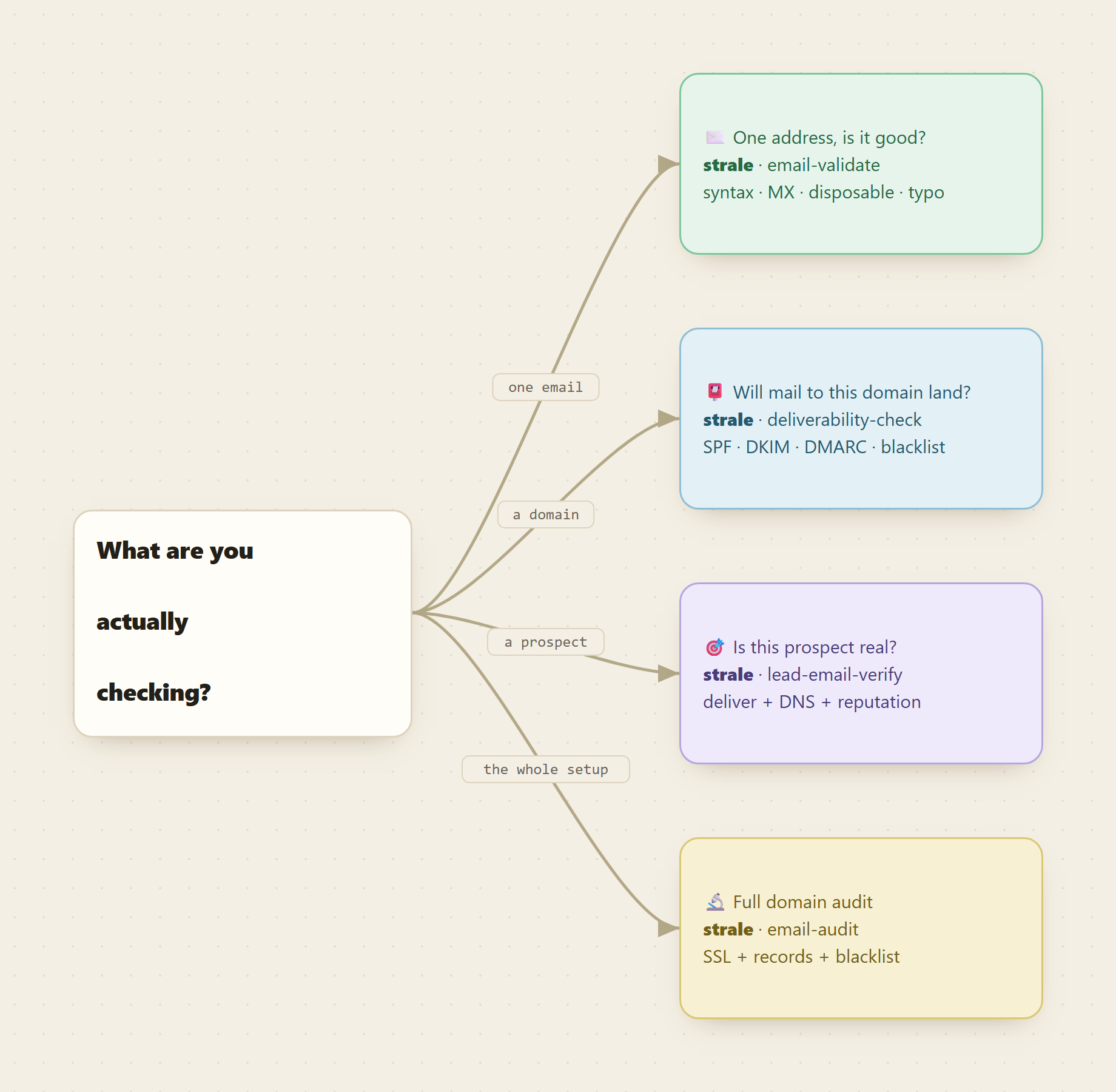
The workhorse for list hygiene is /x402/email-validate. It is a GET that takes one email query parameter and returns the assessment a dedicated verifier gives you: RFC 5322 syntax, MX records, disposable-domain detection across 5,361 known domains, role-based address detection over 35 patterns (info@, sales@, and friends), free-provider flags, and a typo suggestion that catches gmial.com and hands back gmail.com. That is the per-address check that decides whether a row stays on your send list.
monid inspect -p api.strale.io -e /x402/email-validate      # schema + price (free)

monid run -p api.strale.io -e /x402/email-validate \
  --query '{"email": "jane@acme.com"}'
# -> syntax, MX, disposable, role, free-provider, typo suggestion
#    billed per call, a few cents, price shown before it ran
When the question is about the domain rather than one mailbox, /x402/email-deliverability-check takes a domain and returns SPF, DKIM, DMARC, MX, and blacklist status as a 0 to 100 score. That is the call you run before a cold campaign to know whether your own or a partner's domain is even configured to land.
For an agent that just found a prospect's address and needs a single verdict, /x402/solutions/lead-email-verify is a POST with an email body that bundles the deliverability check, DNS, and domain reputation into one answer. It costs more per call than the bare validate because it does more, and a free monid inspect shows the exact schema and price before you commit.
monid run -p api.strale.io -e /x402/solutions/lead-email-verify \
  -i '{"email": "jane@acme.com"}'
# -> real / not real verdict for one prospect: deliver + DNS + reputation
The real difference: a credit pack vs a line item on a shared wallet
Put the prices aside, because at similar volumes they land in the same neighborhood. The structural difference is what your money is shaped like.
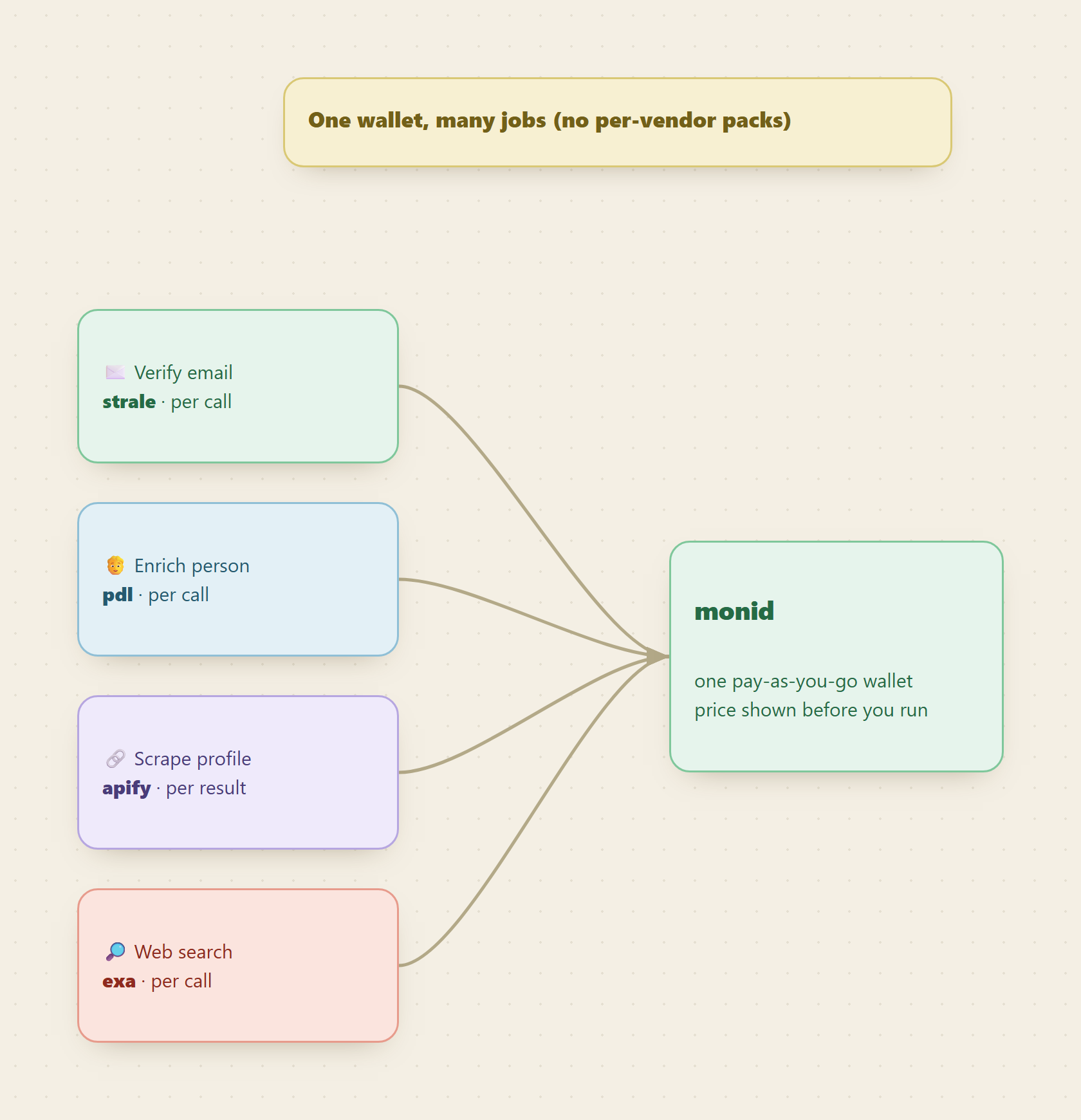
With a dedicated verifier, your money becomes a single-purpose balance. A ZeroBounce pack buys email checks and nothing else. A NeverBounce balance buys email checks and nothing else. If your week also needs a few hundred LinkedIn profiles scraped and a batch of companies enriched, that is two more vendors, two more balances, two more minimums, and two more meters to reconcile.
On Monid, verification is one endpoint among many drawing from the same pay-as-you-go wallet. The dollar you did not spend on email checks is still there for enrichment, scraping, or search. Nothing is pre-committed to a single purpose, nothing expires on a twelve-month clock, and there is no minimum to clear before the first call.
| Dedicated verifier (ZeroBounce / NeverBounce) | Strale on Monid | |
|---|---|---|
| Buy-in | Credit pack or subscription, minimum purchase | None, pay per call |
| Unused balance | Expires or does not fully roll over | Nothing to strand, wallet is shared |
| Scope of the balance | Email verification only | Any of hundreds of endpoints |
| Bulk list of millions | Deep volume tiers, strong fit | Works, but per-call pricing is flatter |
| One address, on demand | Draws down a pre-bought pack | One metered call, price shown first |
| Agent-native (MCP) | Varies by product | Built in |
What a verification run actually costs
Take a realistic agent shape rather than a list clean: a research agent that qualifies leads and hits email-validate roughly a hundred times a day. At a few cents per call, that is a single-digit-dollar day, and it draws from the same wallet as every other call the agent makes. There is no pack to size in advance and no unused credits to write off at year end. When one of those leads is worth a deeper look, one lead-email-verify call folds deliverability, DNS, and reputation into a single verdict for a bit more. The current per-endpoint prices for all of these live at monid.ai/tools, and a free monid discover returns them ranked with provider, description, and price before you spend anything.
Now flip it. If your job is to scrub a five-million-row purchased list once a quarter, run the numbers on a dedicated verifier's deepest volume tier. That tier is built for exactly this, and a flat per-call price will not beat it. Using the right tool means being honest about which job you have.
When a dedicated verifier still wins
This is a fair comparison, so here is where ZeroBounce or NeverBounce is the better pick, not Monid.
- Massive bulk cleaning. At millions of addresses in one pass, the deep volume tiers of a dedicated verifier drop the unit price below a flat per-call endpoint. Buy the pack.
- Bounce-rate guarantees and SMTP depth. If you need catch-all detection, greylisting handling, and a contractual accuracy or bounce guarantee, a specialist that pings mailboxes at scale is purpose-built for it.
- A CSV-upload UI for non-technical users. A marketer who wants to drag a spreadsheet into a dashboard and download a cleaned file is better served by the SaaS product than by a CLI or an API.
- Native ESP integrations and compliance paperwork. One-click Mailchimp or HubSpot hooks, plus the SOC 2 or GDPR data-processing agreements some enterprises require, are things a mature verifier ships and a metered endpoint may not.
If none of those describe you, the credit pack is overhead you are paying for a feature set you will not use.
FAQ
Is Strale on Monid as accurate as ZeroBounce or NeverBounce? For the checks it exposes (syntax, MX, disposable, role, free-provider, typo, and domain-level SPF/DKIM/DMARC/blacklist), it runs the same class of validation. For live SMTP mailbox pinging and catch-all guarantees at bulk scale, a dedicated verifier goes deeper. Match the endpoint to the job.
Do I need a separate account or a minimum purchase? No. You integrate Monid once and fund one pay-as-you-go wallet. There is no credit pack to buy, no minimum to clear, and nothing that expires.
Can I verify a single email without buying credits in bulk?
Yes, that is the point. /x402/email-validate is one metered call, priced per call with the number shown before you run, drawn from the shared wallet.
How is this priced against per-credit verifiers? Per call, at magnitudes in the same neighborhood as entry and mid volume tiers, with no pre-commitment. At the very deepest bulk tiers a dedicated verifier is cheaper per address. Current per-endpoint prices are at monid.ai/tools.
Try it
Run a free monid discover for email verification, inspect /x402/email-validate to see its schema and price, and verify twenty addresses you already know the answer for. If the verdicts match, wire it into the pipeline that found the addresses, and let one wallet cover the whole thing. Start at monid.ai.