Buy vs Build: Email-to-Profile Enrichment
Should you build an email-to-profile enrichment pipeline or call a managed endpoint? An honest per-record cost breakdown of buy vs build.
For almost everyone, buying wins. Turning an email address into a full person profile is a data problem, not a code problem, and the hard part is not the pipeline, it is owning the data underneath it. Unless you already have proprietary identity data, extreme scale, or a hard data-residency rule, a managed endpoint like People Data Labs /v5/person/enrich on Monid costs less per matched record than any DIY stack once you count the parts nobody budgets for.
Copy this line to your agent to price the buy side before you commit to building.
set up https://monid.ai/SKILL.md and use pdl//v5/person/enrich to enrich one email and show the billed price
TL;DR
- Buying is the default answer. Building an email-to-profile pipeline means owning data acquisition, entity matching, verification, freshness, and compliance forever, not writing a script once.
- The buy side is one call: an email in, a person profile out, billed per call in the cents range. Current magnitudes are at monid.ai/tools.
- The build side has a low sticker price and a high true cost. Your real unit is dollars per matched record, and DIY match rates on cold email lists are usually the weak link.
- Building genuinely wins in three cases: you have proprietary first-party data no vendor holds, you operate at a scale where per-call pricing stops making sense, or a residency rule forbids sending identifiers to a third party.
- Match rates vary by segment. Do not trust any table, ours included, over a sample of your own list.
What "build" actually means
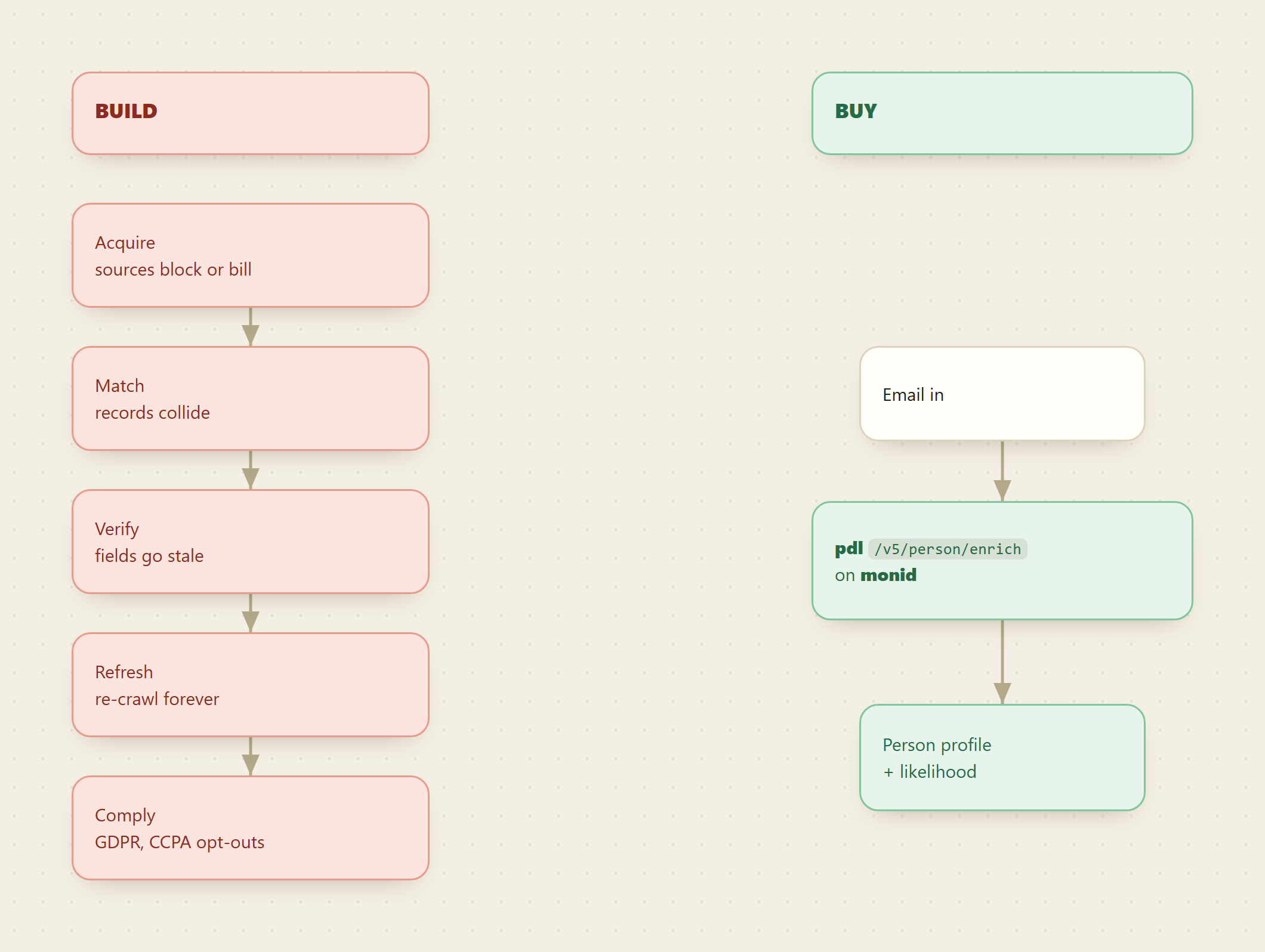
The seductive version of building is a Python script that hits a few free sources and stitches the results together. The real version is a standing system with five moving parts, each of which fails quietly.
Data acquisition comes first. An email like j.torres@northwind.io maps to a person only if you hold data that links the two, so you are scraping or licensing sources, and the sources that carry work history and contact fields either cost money or block scrapers. Then comes entity resolution: deciding that three records across three sources are the same Torres and not two different people, which is a genuine matching problem, not a lookup. Then verification, because a stale title or a dead mailbox is worse than a blank field. Then freshness: people change jobs constantly, and a profile you resolved last quarter is already decaying, so the whole acquisition-and-match loop has to run again on a schedule. Then compliance: person data sits under GDPR and CCPA, which means handling opt-outs, deletion requests, and lawful basis, none of which is optional and all of which is engineering time.
None of that is exotic. All of it is permanent. The script is a weekend. The system is a roadmap.
📖 See also Enriching a List When All You Have Is Email Addresses
The buy side, in one call
The managed side collapses that chain into a request. People Data Labs exposes /v5/person/enrich, a one-to-one match against an identity graph of 3 billion-plus person profiles with over 100 fields per record, including work history, education, social profiles, and contact fields (see the PDL enrichment docs). You pass an email, you get a name, title, company, LinkedIn URL, location, and a likelihood score from 1 to 10 that tells you how confident the match is.
Monid is the OpenRouter for agent tools: one key and one balance reach over a thousand tools across enrichment, scraping, social, and search, with the price shown before anything runs. Discovering an endpoint and reading its schema are free. Only the run bills the wallet.
For agents
Grab an API key at app.monid.ai, then paste this to your agent and hand it the key:
set up https://monid.ai/SKILL.md
It learns the whole discover, inspect, run workflow itself. More details in the agent quickstart.
For humans
npm install -g @monid-ai/cli
monid keys add --label main --key <your-api-key>
More details in the CLI quickstart.
Inspect the schema and price for free, then run one email:
monid inspect -p pdl -e /v5/person/enrich
monid run -p pdl -e /v5/person/enrich -i '{"email":"j.torres@northwind.io","min_likelihood":6}' -w
The endpoint accepts more than email. Per the PDL input parameters, it also takes phone, name, company, profile for a LinkedIn URL, email_hash, and pdl_id, so you match on whatever identifier you happen to hold. If sending raw addresses is a concern, pass email_hash instead.
The comparison that actually decides it
Buy: /v5/person/enrich on Monid | Build: your own DIY stack | |
|---|---|---|
| Time to first result | Minutes | Weeks to months |
| Underlying data | 3B+ profiles, 100+ fields, maintained for you | Whatever you scrape or license, maintained by you |
| Entity resolution | Done inside the match | Your problem to solve and tune |
| Freshness | Vendor re-crawls on its own schedule | You re-run acquisition forever |
| Verification | Ships with a likelihood score | You build and calibrate it |
| Compliance surface | Vendor carries source-side burden; you still govern use | Entirely yours: opt-outs, deletion, lawful basis |
| Cost shape | Per call, cents range, zero when idle | Fixed engineering plus data plus infra, paid whether you run or not |
| Best fit | Bursty or moderate volume, standard person fields | Proprietary data, extreme scale, or strict residency |
The row that flips most decisions is the last cost row. A DIY stack has a floor you pay every month regardless of usage: the engineers who maintain it, the source licenses, the infrastructure. Enrichment demand, for most teams, is bursty. You enrich a few hundred people before a campaign, then nothing for weeks. A per-call endpoint charges nothing in the quiet weeks. A build charges its full floor every week, busy or not.
Per-record cost, reasoned in magnitudes
We do not print rates, because the honest unit is cost per matched record, and that depends on your list and your match rate. Live magnitudes are at monid.ai/tools. The reasoning that survives any price change:
The buy side prices per call in the cents range, so enriching a couple hundred inbound emails lands in the low tens of dollars, and it drops to zero the moment you stop. The build side has almost no marginal cost per record and a very large fixed cost. That means build only wins on cost past a crossover volume: the point where your monthly enrichment count is high enough that the fixed floor, divided across records, finally dips below the per-call price. For a team enriching thousands of records a month on and off, that crossover is rarely reached, because the fixed floor never goes away and the volume never stays high.
There is a subtler trap. A DIY match rate on cold, low-context email lists is usually mediocre, so your true cost per matched record is the fixed cost divided by matches, not by attempts, and a weak match rate quietly doubles it.
📖 See also People Data Labs, Apollo, ZoomInfo: Which Should You Actually Buy?
When building actually wins
Buying is not always right, and pretending otherwise is how vendors lose trust. Build when at least one of these is true.
You hold proprietary first-party data. If your own product generates identity signals no external vendor has, a matching layer over your own graph can beat any bought profile, because the differentiator is the data, and you own it. You operate at extreme, steady scale. Past a high and sustained volume, per-call pricing stops being the cheap option, and amortizing a fixed pipeline across millions of monthly records can win. You have a strict data-residency or contractual rule. If identifiers legally cannot leave your environment or a specific region, sending emails to a third-party endpoint is off the table regardless of cost, and an in-house pipeline is the only compliant path.
If none of those hold, the honest recommendation is to buy, and to spend the engineering you saved on the workflow around the data instead of the data itself.
One honest caveat
Match rates vary by segment, and no published figure predicts yours. A list of US enterprise employees and a list of European small-business owners can enrich at very different rates through the same endpoint. The 3 billion-plus profile count also includes historical and duplicate records, so raw graph size is not the same as coverage of your specific list. Do not trust our table over your own data. Sample a few hundred real emails, run them pay-per-call, measure the match rate and the field completeness you actually need, and let that number decide. The buy-versus-build math only resolves once you know your hit rate, and the only way to know it is to test on the list you have.
That test is cheap. Discover and inspect are free on Monid, and a hundred enrichments cost pocket change, which is a rounding error against a sprint spent building the wrong thing.
FAQ
Is it ever cheaper to build than to buy? Yes, past a crossover point. When your enrichment volume is very high and steady, or when you already own proprietary identity data, amortizing a fixed pipeline can beat per-call pricing. For bursty or moderate volume, buying is almost always cheaper per matched record. Magnitudes are at monid.ai/tools.
What does "hidden cost" of building actually mean? Data acquisition, entity resolution, verification, freshness re-crawling, and GDPR/CCPA compliance. Each is ongoing engineering, not a one-time script, and each fails quietly if you stop maintaining it.
Do I need a People Data Labs account to try the buy side? No. You integrate Monid once and fund one pay-as-you-go balance. People Data Labs is called through the same key, billed at the price shown before the run.
How do I decide without guessing?
Sample a few hundred of your real emails through /v5/person/enrich, measure your actual match rate and the fields you need, then compare that per-matched-record cost against the honest fixed cost of a pipeline you would have to maintain forever.