The Cheapest Way to Scrape X at Scale in 2026
A head-to-head cost and ops comparison of the X API, self-hosted scrapers, and pay-per-call TikHub and Apify endpoints for pulling X data at volume.
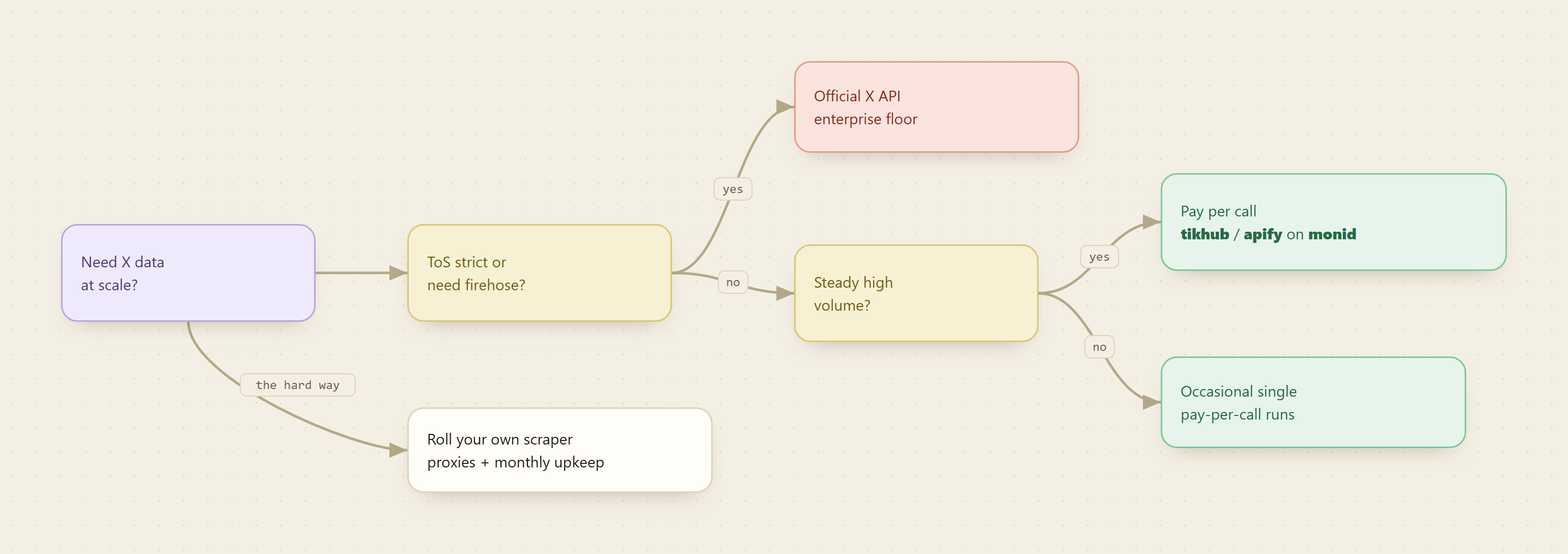
For most teams pulling X (Twitter) data at volume in 2026, the cheapest option is pay-per-call provider endpoints, not the official API and not a scraper you maintain yourself. Metered calls beat a monthly floor because you pay for the rows you actually pull, and they beat a home-grown scraper because someone else eats the proxy bill and the breakage. The official API still wins in one narrow case, and we will be honest about it below. Everywhere else, per-call is the lower number.
Copy this line to your agent to pull X search results and a user timeline at volume, priced per call.
set up https://monid.ai/SKILL.md and use tikhub/twitter to fetch a keyword search timeline and one user's posts
TL;DR
- Cheapest at scale for most teams: pay-per-call X endpoints such as TikHub and Apify's X actors on Monid, billed only when a call runs, with no monthly floor.
- The official X API defaults new developers to metered reads with a hard monthly ceiling, and the only true high-volume lane is a steep enterprise contract. See the X API pricing rundown for the current shape.
- Rolling your own scraper is not free: X sits behind a login wall, rate limits tightened again in 2025, and every crawler breaks every few weeks when X rotates its GraphQL identifiers. Expect 10 to 15 hours a month of upkeep per the scraping teardown.
- Per-call cost is a fraction of a cent to a few cents per result depending on the endpoint. Live magnitudes are on monid.ai/tools.
- Official API is still the right call when you are ToS-sensitive or need firehose completeness. For everything else, per-call wins on both cost and operational load.
The three realistic options
There are only three ways to get X data at volume that hold up in production. The official API, a scraper you run, or a pay-per-call provider. Here is the honest shape of each before the numbers.
The official X API moved to a metered model. As of February 2026, new developers are pushed to pay-per-use by default, the legacy monthly tiers are closed to new signups, and monthly reads are capped at a fixed ceiling per the pricing breakdown. Above that ceiling, the only lane is an enterprise agreement at a steep monthly floor. It is the sanctioned path, and for a lot of use cases it is priced out of reach.
Rolling your own scraper looks free until you run it. X has kept almost all content behind a login wall since 2023, so anonymous access gets you a thin preview and nothing at volume. Datacenter IPs are flagged within a request or two, so you need residential proxies in rotation, and the per-hour request budget was cut again in 2025. Worst of all, crawlers break on a schedule: X rotates guest tokens and GraphQL identifiers every two to four weeks, which the Scrapfly teardown puts at 10 to 15 hours of debugging a month just to keep the thing alive. That maintenance time is a real cost, it just does not show up on an invoice.
Pay-per-call provider endpoints put the scraping problem on someone whose full-time job is keeping it working. On Monid, X data lives behind TikHub and Apify's X actors as ordinary metered endpoints. You do not sign up with each vendor, you do not run proxies, and you pay per call from a single wallet. Monid is the OpenRouter for agent tools: one interface and one balance to discover and execute over a thousand tools (web scraping, people and company enrichment, social data, web search, generative media) without a separate signup per vendor.
Side by side
Neither of the first two options is universally wrong. This table is a routing rule, not a scoreboard.
| Official X API | Self-hosted scraper | Pay-per-call on Monid | |
|---|---|---|---|
| Upfront commitment | Metered reads with a monthly cap, or a steep enterprise floor | Proxy subscription plus your engineering time | None. Discover and inspect are free |
| Cost shape at scale | Capped, then a large monthly contract | Fixed proxy spend plus hidden upkeep | Linear per call, a fraction of a cent to a few cents per result |
| Ops load | Low, but you live inside the cap | High: 10 to 15 hrs/mo of breakage fixes | None. The provider absorbs breakage and proxies |
| Completeness and ToS | Sanctioned, closest to firehose | Fragile, gray-area, breaks often | Provider-mediated, good for read at volume |
| Idle cost | You pay the tier whether you call it or not | Proxies bill monthly regardless | Zero when you make no calls |
| Best when | ToS-strict or you need guaranteed completeness | Almost never once you price your own time | Steady or bursty volume, cost-sensitive teams |
📖 See also metered billing versus a subscription
Per-unit cost, reasoned in magnitudes
We do not print rates, because the only honest unit is cost per row pulled, and that depends on your volume. The reasoning survives any price change:
- The official metered API has a hard monthly read ceiling. Below it you are fine, but the moment you need volume above the cap, your only option jumps to an enterprise floor, so your marginal cost per row goes from small to enormous with nothing in between.
- A self-hosted scraper has a low variable cost but a stubborn fixed cost: residential proxies bill monthly whether you pull a hundred rows or a million, plus the loaded cost of the engineer who patches it every few weeks. Divide that fixed cost by low volume and the per-row number is ugly.
- Pay-per-call is linear. A keyword search or a user timeline pull is a fraction of a cent to a few cents per result, and idle time costs nothing. There is no cap to slam into and no monthly minimum to amortize. Live magnitudes are on monid.ai/tools.
The crossover is clear. If your volume is small and steady, metered anything is cheap. If your volume is large or bursty, per-call stays linear while the official API forces you onto a monthly contract and the scraper forces you onto a maintenance treadmill.
For agents
Grab an API key at app.monid.ai, then paste this to your agent and hand it the key:
set up https://monid.ai/SKILL.md
It learns the whole discover, inspect, run workflow itself. More details in the agent quickstart.
For humans
npm install -g @monid-ai/cli
monid keys add --label main --key <your-api-key>
More details in the CLI quickstart.
Inspect the schema and price for free, then run a search and a user timeline with small limits:
monid discover -q "twitter keyword search tweets at scale"
monid inspect -p tikhub -e /api/v1/twitter/web/fetch_search_timeline
monid run -p tikhub -e /api/v1/twitter/web/fetch_search_timeline -i '{"keyword":"monid","search_type":"Latest"}' --query '{"count":20}' -w
monid run -p tikhub -e /api/v1/twitter/web/fetch_user_post_tweet -i '{"screen_name":"monid_ai"}' --query '{"count":20}' -w
For very large or long-running jobs, Apify's X actors are on the same balance, so you can route heavy pulls there and keep the same billing. Discovery and inspection stay free either way, so you read the exact price before a single paid call.
One honest caveat
Pay-per-call is not the answer for everyone. If you are in a compliance-sensitive seat where the terms of the data source are contractual, or you genuinely need firehose completeness and a guarantee that no matching post was dropped, the official X API is the correct choice and worth its floor. Provider endpoints are optimized for reading X at volume and at low cost, not for a signed completeness SLA. Know which of those you actually need before you optimize for price. For the large middle of teams that want tweets and search results at volume without a monthly commitment, per-call is the cheaper and lighter path, and it is the one we would pick.
FAQ
What is genuinely the cheapest way to scrape X at scale in 2026? For most teams, pay-per-call endpoints like TikHub and Apify's X actors on Monid. You pay per row pulled with no monthly floor and no proxy bill. Magnitudes are on monid.ai/tools.
Why not just use the official X API? It defaults new developers to metered reads with a hard monthly ceiling, and above that the only lane is a steep enterprise contract. Great if you need sanctioned firehose access, expensive if you just need volume.
Isn't running my own scraper free? No. X is behind a login wall, needs residential proxies, and breaks every two to four weeks when it rotates GraphQL identifiers, which is 10 to 15 hours of monthly upkeep per the scraping teardown. Your time is the real cost.
When should I still pick the official API over per-call? When you are ToS-sensitive or need guaranteed completeness. That is the one case where the monthly floor is worth it. For read-at-volume on a budget, per-call wins.
Point your agent at monid.ai and get X data at volume without a monthly floor, one call at a time.