Every Amazon Review for an ASIN, From One Call
Pull every Amazon review for an ASIN with full text from one pay-per-call endpoint on Monid. No Product Advertising API, no five-review cap.
Copy this line to your agent to pull every review for an Amazon ASIN.
set up https://monid.ai/SKILL.md and use apify/axesso_data/amazon-reviews-scraper to pull every review for an Amazon product by ASIN
You can get the full text of every review for an Amazon ASIN from a single pay-per-call endpoint, and the bill scales with how deep you go instead of stopping at an arbitrary cap. Monid is the OpenRouter for agent tools: one interface and one balance reach over a thousand tools across web scraping, enrichment, social data, and search, with no separate signup per vendor. Amazon reviews are one of the endpoints we have verified ourselves, and this is the piece where we explain how we think about the job and why we shaped it this way.
TL;DR
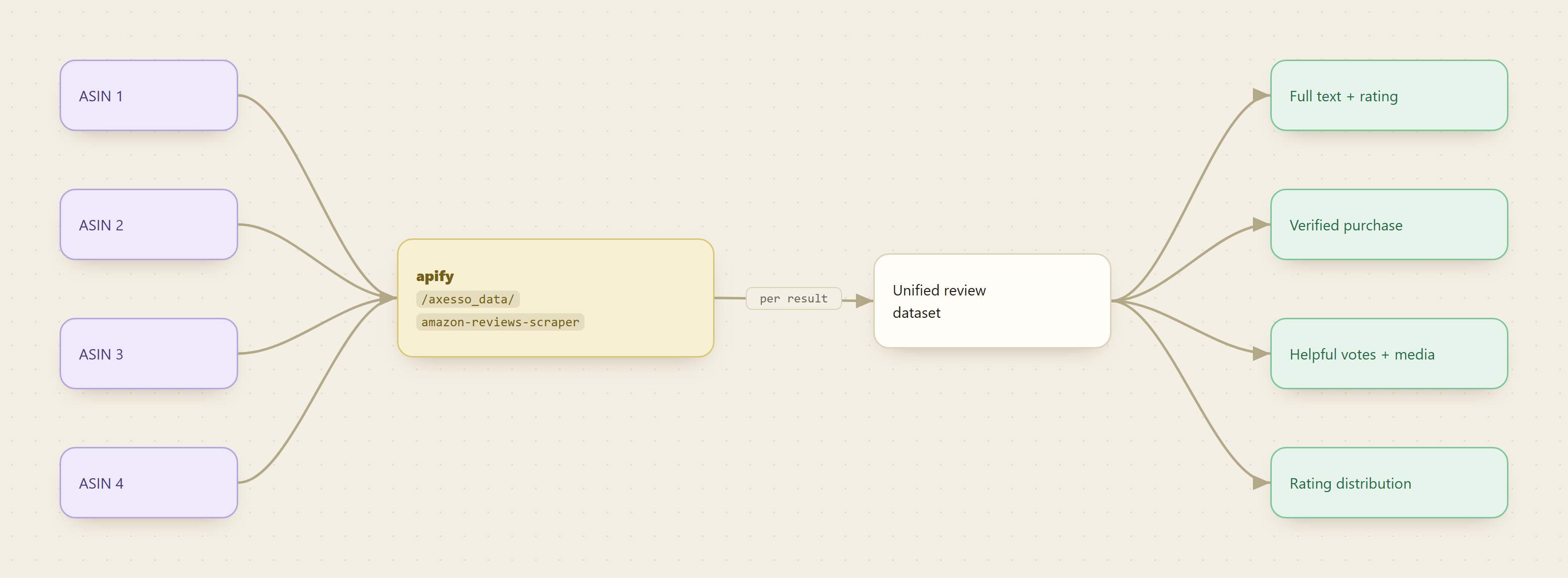
apify /axesso_data/amazon-reviews-scraperreturns real reviews by ASIN with per-review rating, title, full body text, date, reviewer identity, verified-purchase status, helpful votes, media, and an aggregated rating distribution.- It is billed per result, so cost tracks the depth you actually pull. Current prices live at monid.ai/tools.
- Amazon's own Product Advertising API returns a rating count and a star average, not the full text of reviews at any depth. This endpoint returns the text.
- One call accepts a batch of ASINs and filters by star rating, keyword, or reviewer type, so a competitor sweep and a single-product deep dive share the same call shape.
- Monid ships as an MCP server, so an agent can pull reviews mid-task without you wiring a scraper first.
Why the official API does not do this
It is worth being precise about the gap, because it is the reason this endpoint exists. Amazon's Product Advertising API is built to help affiliates surface products, so its customer-reviews resource returns a review count and a star rating, and points you at an embedded iframe for the rest. It does not hand back the body text of individual reviews at any depth. That is the wrong shape for the jobs teams actually bring us: read what buyers wrote, find the recurring complaint, or diff sentiment against a competitor's ASIN.
The common fallbacks are worse. Scrape it yourself and you inherit proxy pools, rotating layouts, and a parser that breaks on the next redesign. Reach for a general reviews tool and you often hit a hard cap, five reviews here, a page there, or a throttle that turns a deep product into a week of paging. We would rather the depth be a line item you control than a wall you argue with. The following principles are how we built toward that.
📖 See also The Best Amazon Reviews API in 2026
1. The full review text is the payload
A star count tells you a product is a 4.3. The reviews tell you why the 1-stars are 1-stars. apify /axesso_data/amazon-reviews-scraper, maintained by scraping specialists on Apify, returns each review's full body text alongside its rating, title, date, reviewer identity, verified-purchase flag, helpful-vote count, and any attached photos or video. It also returns the aggregated rating distribution, so you get both the headline shape and the raw material behind it in one response. Inspect the schema and the price for free before you spend anything:
monid inspect -p apify -e /axesso_data/amazon-reviews-scraper
# -> input schema, field docs, and per-result price (free)
The verified-purchase flag matters more than any other field, because it is the cheapest filter against reviews that were never tied to a real order. The media field matters second, because a photo of a cracked unit is a support signal a sentiment model will miss.
2. Per-result billing scales with the depth you choose
This endpoint is billed per result, which is the design decision that removes the five-review cap. There is no tier that unlocks depth and no throttle that rations it. Pull ten reviews to sanity-check a product, or pull the full history of a best-seller, and you pay for exactly the rows you took. Keep the first run small and let the schema confirm the shape before you scale.
monid run -p apify -e /axesso_data/amazon-reviews-scraper \
  -i '{"asin": "B0EXAMPLE1", "domainCode": "com", "maxReviews": 20}'
# -> Run ID: 01HXYZ...

monid runs get -r 01HXYZ... -o reviews.json
# -> COMPLETED: 20 reviews with full text + verified flag,
#    plus the aggregated rating distribution, billed per result
Thousands of reviews for a product land in the low single-digit dollars, and a twenty-row spot check costs a fraction of a cent. The current per-result price is always shown before the run and listed at monid.ai/tools.
3. Batch ASINs run from one balance
Product research is rarely one ASIN. It is your product against four competitors, or a category you are sizing before you enter it. This endpoint accepts a batch of ASINs across Amazon domains, so a five-product comparison is one call and one bill rather than five accounts and five exports. The same call shape covers the single-product deep dive and the competitor sweep, which is the point.
📖 See also the PA-API retirement guide
4. Filters keep the bill honest
Depth without filters is just a large bill. The endpoint filters server-side by star rating, by keyword, and by reviewer type, so you pull the slice you care about instead of paying to download everything and discarding most of it. Chasing a defect pattern means pulling one and two-star reviews only. Auditing a specific claim means filtering by keyword. Weighting trustworthy signal means restricting to verified purchasers. Each filter is a smaller result set, and per-result billing means a smaller result set is a smaller bill, so precision and cost move in the same direction here rather than fighting each other.
5. MCP-native, so the agent pulls reviews mid-task
Because Monid is also an MCP server, none of this has to be a script you run ahead of time. An agent handed "tell me the top three complaints about this ASIN and whether they come from verified buyers" can discover the endpoint, inspect its price, run it with a one and two-star filter, and read the text back, all inside one task. The discover-inspect-run loop is free until the run, so the agent can shop the catalog before it spends.
FAQ
Do I need Amazon's Product Advertising API or a seller account? No. You integrate Monid once and fund one pay-as-you-go balance. The provider handles Amazon access, proxies, and parser upkeep, and you get full review text the official API does not return.
Is there a cap on how many reviews I can pull per ASIN? No fixed five-review or single-page cap. Billing is per result, so depth is something you choose and pay for, not a wall.
Can I pull several ASINs and other Amazon domains in one call? Yes. The endpoint takes a batch of ASINs and supports Amazon domains beyond .com, from one call and one balance.
How much does it cost? Per result, from a fraction of a cent for a spot check to single-digit dollars for a full-history pull, always shown before the run. Current prices are at monid.ai/tools.
Try it
Grab a key at app.monid.ai, inspect the endpoint for free, and pull twenty reviews from an ASIN you know. If the text and the verified flags match what you see on the listing, filter to the one-stars and scale the pull. For agents, hand yours https://monid.ai/SKILL.md and it learns the discover, inspect, run workflow itself. Humans can start from the CLI quickstart.