One API, 91 Platforms: Five Live Tests of EveryInfra
Guest post by EveryInfra: 58 live requests across 20 platforms, five cases from retail prices to app ratings, with the numbers, limits and billing ledger.
Editor's note. This is a guest post by EveryInfra, a pay-per-call data API and remote MCP server for public data on 91 platforms. The requests, numbers, screenshots and conclusions below are EveryInfra's own, from a test they ran on October 26 and 27, 2026, Singapore time, and are published here as supplied. Monid did not re-run them. The section for Monid readers describes how EveryInfra sees a dedicated data API working next to a tool router; it is their view, and we think it is a fair one.
The same product can get very different star ratings in different places. ChatGPT's latest reviews average 4.38 on Google Play and 4.34 on the App Store. OpenAI's latest Trustpilot reviews average 1.20. In US data engineer job posts, only 14.5% fill the salary field, but another 50% state a pay range in the text. We got these numbers on October 26, 2026, from 10:52 to 11:15 Singapore time (SGT).
We sent 58 requests with one EveryInfra API key. They covered 20 platforms and 30 data capabilities and returned 3,168 rows. Billing charged 43 of them, $0.071703 in total. The 5 failed or empty calls all show charged_usd 0.

Key points
- One key, one endpoint. The catalog had 91 platforms and 426 data capabilities that day. 399 were available. Content and social is the largest group, with 48 platforms and 274 capabilities.
- Platforms differ a lot on the same task. Katz's Delicatessen gets 26.8 new reviews a day on Google Maps and 0.28 on Yelp. For "AI glasses", Reddit posts have a median age of 0.1 days and YouTube results 153.9 days.
- The field is not the whole story. Of 110 US data engineer posts, 16 fill the salary field and 55 more state a range in the text. That is 64.5% in total.
- Failed calls cost nothing, with proof. 4 calls returned 503 and 1 returned no rows. All show
charged_usd0. The ledger shows a full refund of $0.00138889. - Cost. 43 charged calls cost $0.071703. The lowest price for one call is $0.000556.
How we tested
We wrote five rules before we looked at any data, and did not change them later. Each case uses at least two platforms, so one question is compared across platforms. A script computes every number from the raw responses. All exchange rates come from a central bank on a stated date. Failures, empty results and parameter errors are recorded as they happened; we did not retry until success and then hide the failures. Each result states its limits: sample size, date range and open questions.
All requests used one test key and one endpoint, POST https://api.everyinfra.com/api/v1/social. Only the platform, action and params in the body changed. EveryInfra allows 10 requests a minute per key; our first batches were too fast, so 7 requests got a 429 response. Each 429 says "Nothing was charged" and gives the wait time in seconds. We count these 7 requests in the totals.
| Case | Capabilities | Singapore time | Rows returned | Charged (USD) |
|---|---|---|---|---|
| Retail prices: magnetic power banks | amazon/search, walmart/search, ebay/sold, temu/search, alibaba1688/search, amazon/profile | 10:52 to 11:04 | 423 | 0.009181 |
| Social topic: AI glasses | reddit/search, youtube/search, tiktok/search, youtube/comments, plus 4 Chinese platforms | 10:53 to 11:15 | 464 | 0.026366 |
| Local reviews: Katz's and Lau Pa Sat | google_maps_reviews/search, google_maps_reviews/reviews, yelp/search, yelp/reviews, tripadvisor/search, tripadvisor/reviews | 10:55 to 11:01 | 287 | 0.011112 |
| Job market: data roles | linkedin/jobs (4 failed indeed/search calls) | 10:57 to 11:04 | 249 | 0.001112 |
| App reputation: ChatGPT and Temu | app_store/reviews, google_play/reviews, trustpilot/reviews | 11:00 to 11:08 | 1,600 | 0.008334 |
What EveryInfra is: one endpoint and a public catalog
EveryInfra is a platform for public web data. You tell it the platform, the action and the parameters; actions include search, details, comments, rankings and profiles. It returns JSON with named fields. All platforms share one endpoint and one API key, so you do not need a developer account on each platform, and you do not maintain page parsers, pagination or fixes after site redesigns.
The public catalog is the manual. Anyone can read GET /api/v1/social/catalog without a key. Each capability lists its required and optional parameters, allowed values, returned fields, price and current status. We read the catalog at 10:49 SGT on October 26, 2026: 91 platforms, 426 capabilities, 399 available and 27 paused. Among the available ones the lowest price was $0.000556 per call and the median $0.001389; 89.5% cost $0.001389 or less.
| Category | Platforms | Capabilities | Examples in the catalog | Typical use |
|---|---|---|---|---|
| Content and social | 48 | 274 | YouTube, TikTok, Reddit, Instagram, X, Xiaohongshu, Douyin | Topic tracking, creator research, comment analysis |
| Reviews | 15 | 54 | Google Maps reviews, Yelp, Tripadvisor, App Store, Google Play, Booking | Store reputation, app ratings, travel |
| E-commerce | 12 | 49 | Amazon, Walmart, eBay, Temu, Etsy, Shopee, 1688 | Product research, price checks, review mining |
| Jobs and business | 12 | 35 | LinkedIn, Indeed, Glassdoor, Seek, Trustpilot, Capterra | Hiring trends, salaries, company reputation |
| Web and search | 4 | 14 | General web, Yahoo Finance, Yandex, Similarweb | Web pages and market data |
The categories follow the EveryInfra market page, which groups platforms by domain and tags; that is why Trustpilot and Capterra sit under "Jobs and business". If you need one platform, go to its page directly, for example the Amazon API, the YouTube API or the Google Maps Reviews API.
Case 1: Retail prices for one keyword on five platforms
A seller wants to know how a product's price changes from wholesale to retail. We chose magnetic power banks and called amazon/search (amazon.com), walmart/search, ebay/sold (sales in the last 30 days), temu/search and alibaba1688/search (the Chinese keyword). Five requests, 422 rows, $0.007792.
Medians: Amazon US 23 products at $29.99; eBay sold, new condition, 151 sales at $25.11; Walmart 20 products at $23.67; Temu 79 products at $14.28; 1688 wholesale 100 products at CNY 52.0, which is $7.74 at the State Administration of Foreign Exchange central parity rate for October 23, 2026 (USD 1 = CNY 6.7180). So the Amazon median is 1.19 times the eBay sold median, 2.1 times Temu and 3.87 times the 1688 wholesale price.
| Platform | Sample | Median (USD) | Quartile range (USD) | What to know |
|---|---|---|---|---|
| Amazon US | 23 | 29.99 | 21.99 to 49.99 | 9 are Anker. 5 ASINs are color variants of 2 models |
| eBay sold, new | 151 | 25.11 | 15.19 to 42.99 | Sold prices, not list prices. 191 of 200 sold from October 22 to 25 |
| Walmart | 20 | 23.67 | 19.94 to 29.99 | Mostly third-party sellers. Walmart.com sells 2 |
| Temu | 79 | 14.28 | 9.51 to 19.46 | Median discount from the strike-through price: 56.5% |
| 1688 | 100 | 7.74 (CNY 52.0) | 5.43 to 12.15 | Wholesale start price. 66 sellers are in Shenzhen |
Three details in the raw fields change how you use the table. Amazon returned three ASINs for the Anker 621 that all show 21,149 ratings, and two for the Anker 633 that both show 11,810: color variants sharing one review pool, so dedupe by brand and rating count before counting brand share. ebay/sold returns at most 200 rows per call, and 191 of ours were from October 22 to 25, so one call covered four days, not thirty; split by price band or keyword for the full window. Temu's strike-through price is a display field, not a past sale price, so treat the 56.5% "discount" as the seller's choice rather than a measured cut.
Result and limits: one set of requests gets five price bands in about a minute. The ratios apply to this keyword and this sample only. The 1688 price excludes shipping, certification and fees. Use this to answer "what is the price range, and who sells", not to calculate profit. The EU handling fee of EUR 2 per item is expected from November 1, 2026 (see the news section), so compare prices before and after that date separately. Capability pages: eBay sold listings, Amazon search, Walmart API.
Case 2: Social media topics return different time windows
A marketing team wants to know where people discuss "AI glasses", which brands they mention and what users care about. We called youtube/search ("AI glasses review"), tiktok/search and reddit/search ("AI glasses"), searched Xiaohongshu, Douyin, Bilibili and Weibo for the same topic, and read 30 comments under a recent Ray-Ban Meta review on YouTube through MCP.
The first result affects every comparison: one query returns very different time windows on different platforms. Reddit's 25 results have a median age of 0.1 days; Weibo's 50 also 0.1 days; Xiaohongshu's 20, 6.7 days; TikTok's 12, 43.1 days; YouTube's 50, 153.9 days, with only 2 under a week old. Reddit shows today's conversation and YouTube shows the most-watched reviews of the last half year. Add up posts across platforms and you are comparing different periods.
| Platform | Results | Median age (days) | Median likes | Most mentioned brands (posts) |
|---|---|---|---|---|
| 25 | 0.1 | 1 | Meta/Ray-Ban 3, Google/Android XR 2 | |
| 50 | 0.1 | 0 | iFLYTEK 3, Quark 3 | |
| Xiaohongshu | 20 | 6.7 | 5 | Rokid 2 |
| TikTok | 12 | 43.1 | 2,098 | RayNeo 2, Even Realities 2 |
| YouTube | 50 | 153.9 | 1,391 | Meta/Ray-Ban 45, Rokid 16 |
On YouTube, 45 of 50 results mention Meta or Ray-Ban and 16 mention Rokid, a Chinese brand; on Bilibili, 22 of 50 mention RayNeo and 9 Xiaomi. These are not market share, only who appears in search results, but a team that watches only US platforms misses the Chinese brands, and the reverse holds too.
Comments show what users ask. In 30 YouTube comments, 7 compare the second and third generation of Ray-Ban Meta and 3 mention a display or HUD. In 171 comments on Chinese platforms the top theme is live translation (14), then prescription lenses (6) and battery (6); only 2 ask about price.
| Comment theme | YouTube, 30 comments | Chinese platforms, 171 comments |
|---|---|---|
| Upgrade (second vs. third generation) | 7 | 0 |
| Display or HUD | 3 | 0 |
| Live translation | 0 | 14 |
| Prescription lenses | 0 | 6 |
| Battery and charging | 1 | 6 |
| Price | 2 | 2 |
Result and limits: align the time windows first, then compare counts and engagement. Samples are small (TikTok 12, Reddit 25) and are the platform's own ranking, not the full conversation. Brand matching is by keyword, so nicknames and model numbers are missed. See the YouTube search API, the Reddit API and the TikTok API.
Case 3: Local reviews arrive at very different speeds
Which platform should you read for a place's reputation? We chose Katz's Delicatessen in New York and Lau Pa Sat in Singapore, a Victorian food market made a national monument in 1973 (Roots, National Heritage Board). We found each place with the search capability, then read the newest reviews: Google Maps and Yelp for Katz's, Google Maps and Tripadvisor for Lau Pa Sat.
The largest difference is speed. Katz's newest 100 Google Maps reviews span 3.7 days, 26.8 a day; its newest 10 Yelp reviews span 35.9 days, 0.28 a day, a 95.7 times gap. Lau Pa Sat's newest 100 Google Maps reviews span 12.1 days, 8.27 a day; its newest 50 Tripadvisor reviews span 297 days, 0.17 a day, a 48.6 times gap. For what went wrong last week, Google Maps gives tens of times more reviews; for long reviews with trip context, Tripadvisor is more complete, and all 50 of its reviews had text and a trip type.
| Measure | Katz's, Google Maps | Katz's, Yelp | Lau Pa Sat, Google Maps | Lau Pa Sat, Tripadvisor |
|---|---|---|---|---|
| Page rating / total reviews | 4.5 / 56,283 | 4.1 / 17,124 | 4.4 / 39,338 | 4.2 / 2,567 |
| Reviews we read | 100 | 10 | 100 | 50 |
| Time span (days) | 3.7 | 35.9 | 12.1 | 297.0 |
| New reviews per day | 26.8 | 0.28 | 8.27 | 0.17 |
| Mean stars, latest batch | 4.45 | 4.20 | 4.61 | 4.40 |
| Reviews with text | 56 | 10 | 34 | 50 |
Of Katz's newest 100 Google Maps reviews, 56 have text and 7 are one star; at Lau Pa Sat only 34 of 100 have text and 74 come from Local Guide accounts. This is why the official APIs are not enough here: Google's Places API documentation says a place returns up to five reviews, and Yelp's reviews endpoint returns up to three excerpts. Separate the page rating from the latest batch: Katz's page shows 4.5 and the newest 100 average 4.45; for an owner, "the last two weeks are 0.2 above the long-term average" says more than "4.4 overall".
Result and limits: the ratios come from two places and one batch each; tourist spots and small shops will differ. Yelp returns at most 10 reviews per call. Remove names and avatars before analysis; all statistics here use only stars, dates and text themes. Capability pages: Google Maps reviews, Yelp reviews.
Case 4: The job market keeps salaries in the text
Recruiters and labor researchers want skills and pay for a role in different cities. We called linkedin/jobs for "data engineer" in the United States (110 posts) and "data analyst" in Singapore (139 posts), $0.001112 together. Four indeed/search calls returned 503 and none was charged.
Of the 110 US posts, 16 (14.5%) fill the structured salary field. A regular expression for a "number to number" pay range in the description text found 55 more, so 71 posts state pay, 64.5%. Read only the field and you miss three quarters of the pay data. In Singapore, 2 posts fill the field and 3 more state a range in the text, 3.6%.
The gap has a legal reason. New York Labor Law Section 194-B requires a pay range from employers with four or more employees (New York State Department of Labor); Washington requires a salary range from employers with 15 or more (Washington L&I); Colorado's Equal Pay for Equal Work Act requires pay disclosure in all postings (Colorado CDLE). Singapore has no general rule, but Employment Pass roles must be advertised on MyCareersFuture with a salary range (Ministry of Manpower), so LinkedIn is not where Singapore pay data lives.
Skills give scale: in US data engineer posts SQL appears in 80.0%, Python 71.8%, AWS and Databricks 42.7% each, Spark 41.8%, Airflow 24.5%, dbt 20.0%. In Singapore data analyst posts SQL 75.5%, Python 64.0%, Power BI 54.7%, Tableau 47.5%. Large language models or generative AI appear in about one post in ten (10.9% US, 12.9% Singapore).
Two traps: applicant counts are bands (44 US posts show exactly 200, the "over 200" label; 24 show 25, the "first 25" label), so a median of 137.5 is a lower bound; and the 110 US posts have only 93 distinct title and company pairs, Deloitte alone has 10, so a simple count overstates hiring at large firms.
Result and limits: pay is more often in the text than in the field, so extract it from the text first; our regex misses "up to $200K" and hourly rates, so 64.5% is a lower bound. LinkedIn's Job Posting API does not accept new partners and is for posting jobs, not reading other companies' jobs. Capability page: LinkedIn jobs.
Case 5: One product, three places, three scores
Growth teams and investors use app store ratings as a reputation signal. We read the newest 500 US App Store reviews of ChatGPT and of Temu, the newest 200 Google Play reviews of each, and the newest 100 Trustpilot reviews of openai.com and temu.com. Six requests, 1,600 reviews, $0.008334.
| Product | Platform | Sample | Mean stars | One-star share | Five-star share | Time span |
|---|---|---|---|---|---|---|
| ChatGPT | App Store | 500 | 4.34 | 11.6% | 78.0% | Oct 22 to 24 |
| ChatGPT | Google Play | 200 | 4.38 | 8.0% | 73.5% | Oct 25 |
| OpenAI | Trustpilot | 100 | 1.20 | 89.0% | 2.0% | Aug 18 to Oct 25 |
| Temu | App Store | 500 | 3.21 | 33.4% | 42.4% | Oct 13 to 24 |
| Temu | Google Play | 200 | 4.02 | 17.0% | 63.0% | Oct 24 to 25 |
| Temu | Trustpilot | 100 | 1.65 | 77.0% | 10.0% | Oct 21 to 26 |
The reason is who writes where. Trustpilot returns a source field for each review, and 99 of Temu's 100 are "Organic": users who came on their own, often with a problem. App stores ask inside the app, so satisfied users also rate. App store scores are closer to everyday satisfaction; Trustpilot scores are closer to how unhappy people with problems are (Trustpilot Trust Centre). Do not use one in place of the other. Versions matter too: Temu 4.90.0 has 132 App Store reviews at a mean of 2.92, against 3.34 for 4.89.0 and 3.28 for 4.92.0.
Result and limits: the latest scores for one product differ by more than 3 stars across three platforms, mostly because of how each collects reviews. Samples are the newest batch and span from about one hour to more than two months. The official routes serve only your own apps: Apple's App Store Connect API and the Google Play Developer API reviews.list. Capability pages: App Store reviews, Google Play reviews, Trustpilot reviews.
Compared with other ways: your own scraper, official APIs, general web scraping
| Item | Your own scraper | Official platform APIs | General web scraping | EveryInfra (tested here) |
|---|---|---|---|---|
| Whose data | Any public page | Mostly your own account or app | Any public page | Public data from the 91 platforms in the catalog |
| Data per call | Your choice | Google Places up to 5 reviews per place; Yelp up to 3 excerpts | One page | Up to 500 rows in one call in this test (app_store/reviews) |
| Access | Open | TikTok Research API for non-profit researchers in the US and Europe; LinkedIn's job API accepts no new partners | Sign up | Sign up, one key |
| Quota and price | Servers, proxies and people | YouTube 10,000 units a day by default; X caps reads at 3 million posts a month | Per request or per page | From $0.000556 per call; failed and empty calls are not charged |
| What you get | HTML you parse | Structured fields | HTML, a rendered page or text | JSON with named fields the catalog lists |
| Site redesigns | You fix them | The platform maintains the API, but can retire or narrow it | You fix the parser | EveryInfra maintains it |
The table contains only facts you can check and does not rank the options; each makes sense for some needs.
Three ways to connect: curl, Python and MCP
All platforms use the same endpoint; only platform, action and params change. The Amazon request from Case 1, exactly as sent:
curl -X POST https://api.everyinfra.com/api/v1/social \
  -H "Authorization: Bearer $EVERYINFRA_API_KEY" \
  -H "Content-Type: application/json" \
  -d '{"platform":"amazon","action":"search","params":{"keyword":"magnetic power bank","domain":"amazon.com","limit":50}}'
At 10:52 SGT this took 56.5 seconds and returned 23 products; billing.charged_usd was 0.002236. For Walmart, change only "platform":"walmart" and drop the domain; the response has the same shape, with the rows in results and the charge in billing. In Python, the requests library is enough; the response fields match response_fields in the catalog, 20 of them for amazon/search.
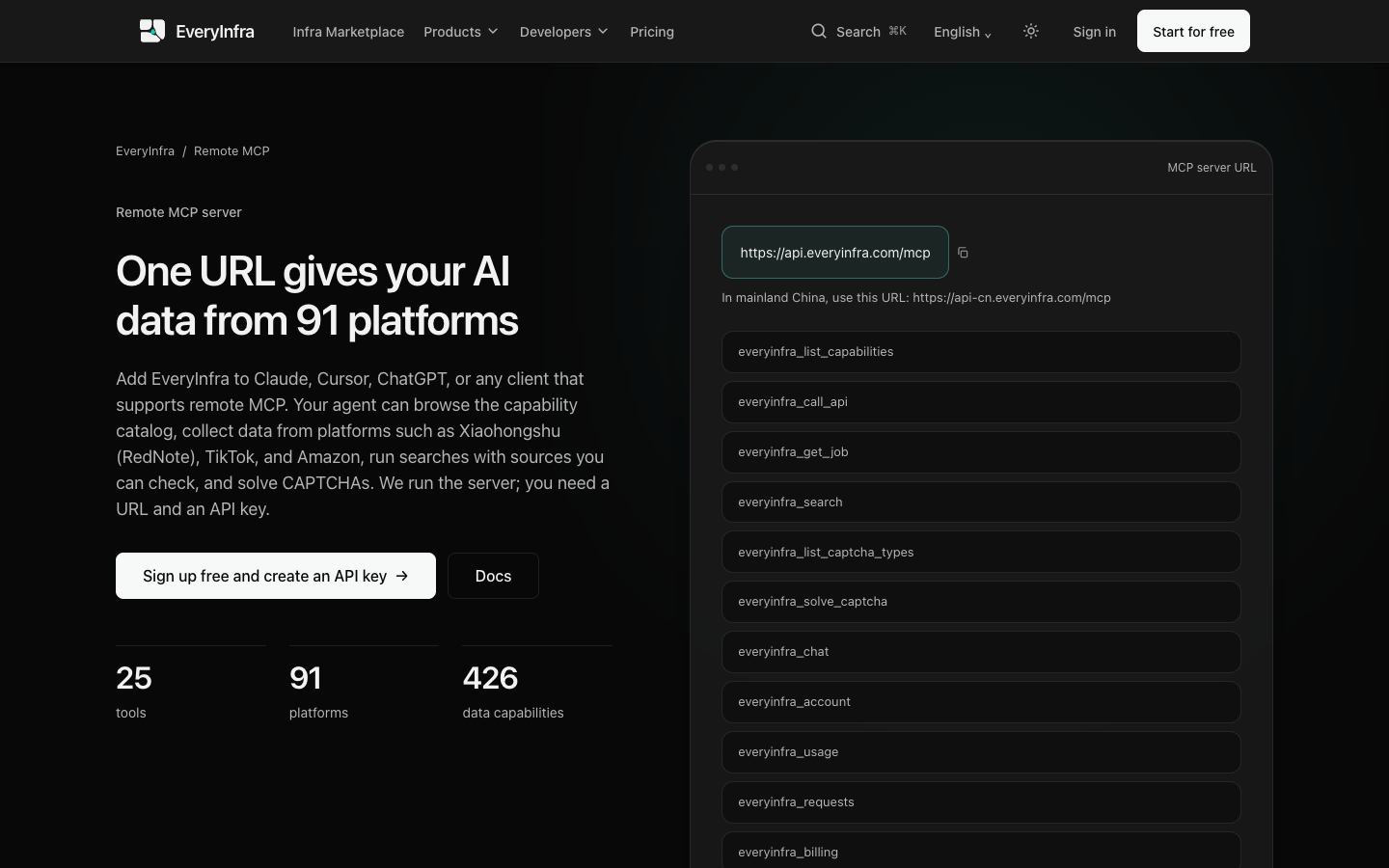
EveryInfra also runs a remote MCP server at https://api.everyinfra.com/mcp with 25 tools, for Claude, Cursor, ChatGPT and any client that supports remote MCP:
{
  "mcpServers": {
    "everyinfra": {
      "url": "https://api.everyinfra.com/mcp",
      "headers": { "Authorization": "Bearer <your EveryInfra API key>" }
    }
  }
}
At 11:06 SGT we used the MCP tool everyinfra_call_api to read the Weibo trending list: 46 topics, $0.000556, the same price as a direct call. The MCP result is the API JSON, in result.content[0].text. We asked for protocol version 2026-07-28 in the handshake; the server agreed on the 2025-11-25 version, which current clients accept. Setup is on the remote MCP setup and MCP server pages.
Billing and free failures: the ledger of 58 requests
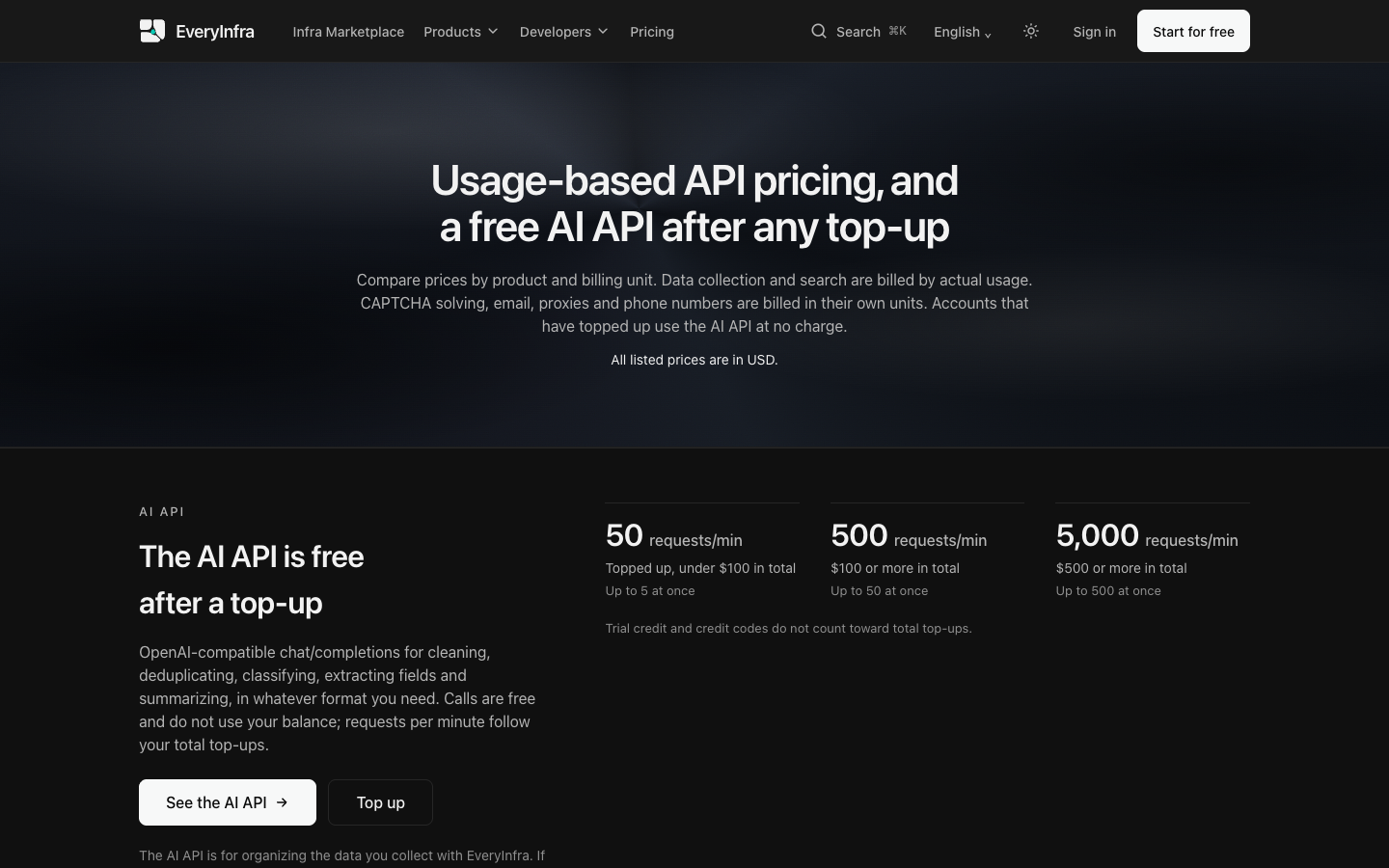
EveryInfra charges per call, with no monthly fee, and each response shows the charge in billing.charged_usd. Of 58 requests, 43 succeeded and were charged, $0.071703 in total. 5 failed or returned no rows and all show charged_usd 0. 9 were rejected before any work started (7 got 429, 1 got 422, 1 got 401) and never reached billing. The last was a free ledger lookup.
The failed calls show the most. indeed/search returned 503 with billing.charged false, charged_usd 0 and reason request_failed_refunded; the MCP tool everyinfra_requests then showed the settlement record: an original amount of $0.00138889, a refund of $0.00138889, a final amount of 0. The system holds the price first and refunds the same record in full when the call fails. An ebay/sold call sent on purpose with a minimum price of $999,999 returned 0 rows with reason empty_result_refunded and charged_usd 0.
Bad parameters stop before any work starts. sort: "new" to reddit/search returned 422:
{"error": {"code": "invalid_value",
  "message": "`sort` must be one of: controversial, newest, popular, relevance, rising, top (got 'new')",
  "param": "sort", "did_you_mean": ["newest"],
  "next_steps": ["Change only `sort` to a value in `allowed`, then resend. Nothing was charged."]}}
An AI client can read did_you_mean, change the value and send again; we did, and the call returned 25 posts for $0.000556.
Four capabilities, Douyin comments among them, show rows_per_unit: 20 in the catalog and bill per block of 20 rows (Douyin catalog entry): we asked for 150 comments, the system held 8 blocks, 75 came back, 4 blocks were charged ($0.002222) and 4 refunded at once. All other capabilities charge one price per call whatever the limit, so set the limit to the maximum the capability allows; our app_store/reviews call returned 500 reviews for $0.001389. The 40 successful synchronous calls took 2.4 to 92.0 seconds, median 20.9; failed calls returned in 0.1 to 2.4 seconds. For real-time apps use async mode for slow capabilities. See the pricing page and failure refund reconciliation.
For Monid readers: one router for many tools, one direct line for daily data
Monid readers build agents that choose their tools at run time. The Monid website says its catalog has more than 2,800 tools from more than 90 providers, behind one prepaid balance with no subscription, and new accounts start with $1 in free credit. An agent connects through a remote MCP server at https://mcp.monid.ai/v1 (quick start for MCP, read on October 27, 2026); the Monid llms.txt file also lists a skill, a CLI and a REST API.
Monid's own skill file gives an agent an order of preference: first an explicit instruction from the user, second the user's own dedicated tools such as an MCP server or a personal API key for that service, third Monid for the needs the first two do not cover (SKILL.md, version 0.1.8, read on October 27, 2026). So Monid expects agents to run next to dedicated tools, not instead of them.
Which work goes to a dedicated data tool? We think it is the work that repeats. An agent that checks the same keywords on the same platforms every morning gains from a fixed schema and a fixed price list; an agent that needs a weather lookup once a month gains from a router. We tested the repeat case with the topic Monid uses in its own creator tutorial: matcha. On October 27, 2026, from 13:18 to 13:26 SGT, we sent seven requests with one EveryInfra key.
| Time (SGT) | Capability | Input | Rows | Time to answer | Charge |
|---|---|---|---|---|---|
| 13:18:17 | xiaohongshu/search | Chinese keyword for "matcha latte", most liked first | 20 | 3.6 s | $0.005556 |
| 13:18:21 | douyin/search | Chinese keyword for "matcha latte", limit 20 | 12 | 14.8 s | $0.000556 |
| 13:18:35 | tiktok/search | keyword "matcha latte", limit 30 | 30 | 15.2 s | $0.000556 |
| 13:18:51 | tiktok/search | parameter query instead of keyword | HTTP 422 | n/a | $0 |
| 13:19:09 | xiaohongshu/search, async | keyword "matcha latte" | 20 | job ID in 3.4 s | $0.005556 |
| 13:19:15 | MCP tools/list | n/a | 25 tools | 0.1 s | $0 |
| 13:25:54 | xiaohongshu/search | keyword "matcha latte", most liked first | 20 | 3.6 s | $0.005556 |
The seven requests cost $0.017780. The three platforms return different fields, but each result has like_count, comment_count, posted_at, author_id and url, so an agent can put the lists in one table without a separate mapping step. Beyond the shared five the fields differ, and an agent should know which number it can rank on:
| Field | Xiaohongshu (20 rows) | Douyin (12 rows) | TikTok (30 rows) |
|---|---|---|---|
view_count | Not returned | Not returned | 30 of 30 |
collect_count (saves) | 20 of 20 above 0 | 8 of 12 above 0 | 30 of 30 above 0 |
author_follower_count | Not returned | Returned, 0 in all 12 rows | 30 of 30 above 0 |
| Platform-only fields | is_goods_note, 1 of 20 true | search_rank, 12 of 12 | is_ad, country, language |
So "rank by views" works on TikTok only; on Xiaohongshu and Douyin rank by likes or saves, and do not read a missing view count as zero. On Douyin the follower field came back as 0 for every author, so vet a creator with douyin/profile first ($0.000556 a call, the same as one search).
Three more things an agent should know before it trusts one search. The query language changes the result a lot on Chinese platforms: with the same "most liked" sort, the Chinese keyword on Xiaohongshu returned notes with a median of 3,645 likes, the English keyword a median of 902.5, about a quarter. "Most liked" is not "recent": only 2 of the 20 most liked Xiaohongshu notes were 30 days old or newer, with a median age of about 72 days, against 19 of 30 on TikTok and 6 of 12 on Douyin; if the task says "this week", sort by time or filter on posted_at. And a limit is a maximum, not a promise: Douyin returned 12 of the 20 we asked for and still cost one call, so check count and ask for the next page.
The wrong-parameter call returned HTTP 422 with missing_param, param: keyword, the text "Add the required keyword (query is not a parameter here); example is a working request. Nothing was charged." and a complete working request, so an agent can fix and retry in one step. The async call answered HTTP 202 with a job_id in 3.4 seconds, and the poll of /api/v1/jobs/{job_id} three seconds later returned 20 rows.
Can one agent use both? The MCP architecture overview says a host connects to one or more MCP servers, one client each, so Claude Code, Claude Desktop or your own host can keep Monid and EveryInfra connected at the same time. Give the agent a short rule:
Daily data: for Xiaohongshu, Douyin and TikTok searches on the topics below,
call everyinfra_call_api. Use the native language of each platform for the keyword.
Sort by time when the task says "this week". If count is lower than you need,
ask for the next page. On HTTP 422, apply next_steps and example, then retry once.
Log billing.charged_usd for each call.
Everything else: for other tools and one-off lookups, use Monid
(discover, inspect, run), as its skill file describes.
Topics: matcha latte
Run the three searches from our test once each morning for 30 days and the month costs $0.20004, a number the agent knows before it starts because each search has one fixed price in the catalog. On EveryInfra a failed or empty call costs $0, so a bad hour on one platform does not raise the bill. The Xiaohongshu data API, Douyin data API and TikTok data API pages list every field and price.
What you cannot get
EveryInfra returns only publicly visible data. It cannot get content that needs a login, such as private messages, friends-only posts, or seller back-office orders and ad reports; use the platform's official API with your own authorization for that. It cannot get platforms or fields that are not in the catalog; check the catalog first, or open a ticket in the console.
| Limit | What we saw in this test | What to do |
|---|---|---|
| Login-only data | Not available by design | Use the official API with your own authorization |
| Ranked results, not every post | TikTok 12 posts, Reddit 25 posts | Use pages, time slices or more keywords |
| Row cap per call | eBay 200 rows covered 4 days | Split by price band or keyword |
| Temporary failures | 4 of 4 Indeed calls returned 503 | Retry with backoff, and alert on repeated failures |
| Unrelated rows | A random string on Xiaohongshu returned 20 notes | Filter by posted_at and by keyword after the call |
The availability endpoint showed a normal status for Indeed while all four calls failed, and the catalog lists 27 paused capabilities; failed calls cost nothing but can delay your job. We also searched Xiaohongshu with a random string and a 24-hour limit: the platform returned 20 unrelated notes from 2025 and 2026, and the call was charged $0.005556, so always filter rows by posted_at after you get them.
Public does not mean free to copy, republish or sell. Remove or aggregate personal data before analysis and display; this article uses only aggregated results. Whether your use is allowed under the law and the platform terms is your decision; read Google's user contributed content policy, the platform terms and the robots.txt rules before you start.
Industry news: changes in the last 60 days
| Date | Change | Source | What to do |
|---|---|---|---|
| August 27, 2026 | YouTube counts a public view when playback starts; viewCount description changed | YouTube Data API revision history | Split view-count trends at this date |
| September 30, 2026 | Reddit sets dates to close its public data API (new requests stop October 31, 2026; all public access closes March 2027) and RSS (November 13) | r/redditdev announcement | Plan a new source before January 12, 2027 |
| October 5, 2026 | EU guidance: EUR 2 handling fee per item expected from November 1, beside the EUR 3 temporary duty | DG TAXUD guidance, Delegated Regulation (EU) 2026/2152 | Compare EU prices before and after November 1 |
| October 20, 2026 | EssilorLuxottica Q3 revenue EUR 7,486 million, up 7.2% at constant rates; wearables up 20%; new AI glasses for the holiday season | Q3 2026 press release | Track AI glasses with fixed keywords and windows |

FAQ
Is scraping public data legal? We do not give legal advice. As a data method, EveryInfra returns only publicly visible data; it does not log in and does not get past paywalls. Public data is still not free to use for any purpose: personal data, republishing and commercial use depend on the law where you are and on the platform terms. Ask your legal team about your specific use.
What is the difference between web scraping and an API? An official API gives the structured data a platform chooses to share, usually limited to your own account or app and with quotas. Web scraping gets the content a page shows in public, and you parse and maintain it. EveryInfra sits between the two: it gets public data and returns JSON with fixed fields.
Do failed calls cost money? No. In this test, 4 calls that returned 503 and 1 empty result show charged_usd 0, and the ledger shows a full refund. Calls that get 401, 422 or 429 stop before any work starts and never reach billing. Capabilities that bill per block charge only for the blocks that came back.
How long does one call take? The 40 successful synchronous calls had a median of 20.9 seconds and a range of 2.4 to 92.0. The server gives a synchronous call about 85 seconds, so set the client timeout to 300 seconds; for slower tasks add "mode": "async" and poll the job, which is free.
Can AI agents use multiple MCP servers at once? Yes. A host connects to one or more MCP servers and creates one client for each, so an agent can keep EveryInfra and a tool router such as Monid connected together. Give it a rule for which server handles which task, as in the section for Monid readers, and a separate API key with a spending limit for each agent.
How do I start? Sign up at everyinfra.com, create an API key in the console and follow the quick start. Read the capability catalog first, try one target with a small limit, then scale up.
References
- EveryInfra capability catalog (no key needed), read October 26, 2026: https://api.everyinfra.com/api/v1/social/catalog
- EveryInfra Douyin catalog entry (with rows_per_unit): https://api.everyinfra.com/api/v1/social/catalog?platform=douyin
- EveryInfra capability availability (Indeed): https://api.everyinfra.com/api/v1/social/availability?platform=indeed
- EveryInfra OpenAPI 3.0 specification: https://api.everyinfra.com/openapi.json
- Model Context Protocol Specification 2025-11-25: https://modelcontextprotocol.io/specification/2025-11-25
- MCP Specification 2026-07-28 key changes: https://modelcontextprotocol.io/specification/2026-07-28/changelog
- Q3 2026 Revenue, EssilorLuxottica, October 20, 2026: https://www.essilorluxottica.com/en/newsroom/press-releases/q3-2026-revenue/
- The temporary EUR 3 customs duty and the Union handling fee, European Commission DG TAXUD, October 5, 2026: https://taxation-customs.ec.europa.eu/document/download/053e5b4e-f0be-4f20-9a23-3e3b659a6676_en?filename=Customs%20Guidance%20on%20EUR%203%20customs%20duty.pdf
- Commission Delegated Regulation (EU) 2026/2152: https://eur-lex.europa.eu/eli/reg_del/2026/2152/oj/eng
- RMB central parity rates, State Administration of Foreign Exchange (China), October 23, 2026: https://www.safe.gov.cn/AppStructured/hlw/RMBQuery.do
- YouTube Data API revision history, entry of August 27, 2026: https://developers.google.com/youtube/data/revision_history
- Place Details (Legacy), Google Maps Platform: https://developers.google.com/maps/documentation/places/web-service/legacy/details
- Google Play Developer API reviews.list: https://developers.google.com/resources/api-libraries/documentation/androidpublisher/v3/python/latest/androidpublisher_v3.reviews.html
- List all customer reviews for an app, Apple App Store Connect API: https://developer.apple.com/documentation/appstoreconnectapi/get-v1-apps-_id_-customerreviews
- TikTok Research Tools: access and eligibility: https://developers.tiktok.com/products/research-api/
- X API pay-per-usage pricing: https://docs.x.com/x-api/getting-started/pricing
- Yelp Places API: Reviews: https://docs.developer.yelp.com/reference/v3_business_reviews
- Job Posting API overview, LinkedIn (Microsoft Learn): https://learn.microsoft.com/en-us/linkedin/talent/job-postings/api/overview
- Consider all candidates fairly, Ministry of Manpower Singapore: https://www.mom.gov.sg/passes-and-permits/employment-pass/consider-all-candidates-fairly
- Pay Transparency, New York State Department of Labor: https://dol.ny.gov/pay-transparency
- Equal Pay and Opportunities Act Q&A, Washington State L&I: https://lni.wa.gov/workers-rights/wages/equal-pay-opportunities-act/equal-pay-and-opportunities-act-qa
- Equal Pay for Equal Work Act, Colorado CDLE: https://cdle.colorado.gov/dlss/labor-laws-by-topic/equal-pay-for-equal-work-act
- The Lau Pa Sat Festival Market, National Heritage Board Singapore (Roots): https://www.roots.gov.sg/collection-landing/listing/1186692
- Trustpilot Trust Centre: https://corporate.trustpilot.com/trust
- RFC 9309: Robots Exclusion Protocol: https://www.rfc-editor.org/rfc/rfc9309.html
Guest post by EveryInfra; the test, numbers and screenshots are theirs.
Published October 2026.