The Day I Stopped Paying Clearbit for Firmographics
How I replaced a company enrichment subscription with pay-per-call lookups on Monid, using People Data Labs and Akta from one balance.
Copy this line to your agent to enrich a company from its domain.
set up https://monid.ai/SKILL.md and use People Data Labs to enrich company firmographics for example.com
You do not need an enrichment subscription to turn a domain into firmographics anymore. I pass company domains to a pay-per-call endpoint, pay a fraction of a dollar per company, and pay nothing at all in the months I run no enrichment. That is the whole story, but the way I got there might save you a renewal conversation.
TL;DR
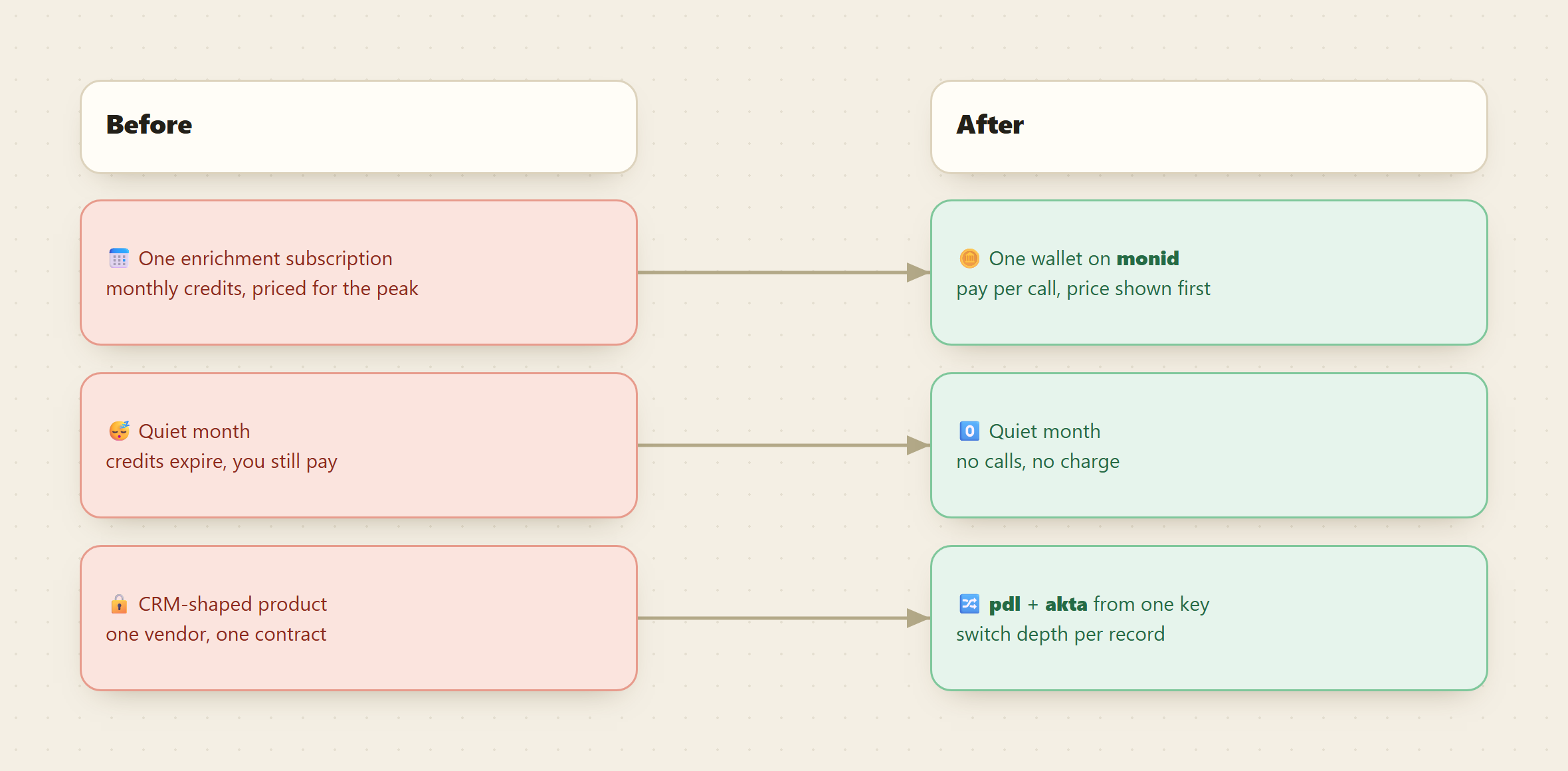
- My enrichment usage was bursty: a few hundred domains before an outreach push, then weeks of silence. Subscriptions price for the peak, so I was paying for the silence.
- Clearbit is now part of HubSpot's Breeze Intelligence, which is great if you live in HubSpot and awkward if you just want an API.
- On Monid I call People Data Labs
/v5/company/enrichfor the classic firmographic record, priced per call in the cents range (current pricing at monid.ai/tools). - When I need depth, Akta
/v1/company/enrichmentreturns 75+ fields across sections likefinancial_estimateanddigital_presence, and asectionsfilter keeps the response scoped. - One API key, one balance, both vendors. No sales call.
Why I was paying for enrichment in the first place
I keep lists of companies. Prospects for my projects, tools I am comparing, companies behind interesting job posts. The question is always the same: what does this company actually do, how many people work there, where is it, and has it raised money. Answering that by hand means twenty browser tabs per domain. Answering it with an enrichment API means one call per domain, which is why Clearbit became the default answer for a whole generation of us.
And to be fair, the product was good. The data was clean, the docs were pleasant, the logo API was free forever. My problem was never quality. My problem was the shape of the bill. My usage looked like a heartbeat monitor: a spike of a few hundred lookups when I prepared an outreach batch or sized up a niche, then a flat line for six or eight weeks. A subscription with monthly credits prices you for the spike and quietly charges you for the flat line.
Then Clearbit got acquired by HubSpot and became Breeze Intelligence. No complaints, it is a sensible home for the data. But it made the direction clear: enrichment as a feature inside a CRM suite, not enrichment as a neutral API you call from a script. I am a person with a script. 🙂
📖 See also whether to buy the dataset or call the API
What I do now instead
Monid is the OpenRouter for agent tools: one key and one balance reach over a thousand tools across enrichment, scraping, social data, and search, with the price shown before anything runs. Searching the catalog and reading schemas is free; only executing a call bills the wallet.
For agents
Grab an API key at app.monid.ai, then paste this to your agent and hand it the key:
set up https://monid.ai/SKILL.md
It learns the whole discover, inspect, run workflow itself. More details in the agent quickstart.
For humans
npm install -g @monid-ai/cli
monid keys add --label main --key <your-api-key>
More details in the CLI quickstart.
A domain goes in, a company record comes out
For the classic firmographic lookup I use People Data Labs' company enrichment endpoint. A free schema check shows what it accepts:
monid inspect -p pdl -e /v5/company/enrich
# -> input schema, docs, and the per-call price (free)
The input is more flexible than I expected. You can pass a website, a company name, a LinkedIn profile URL, or even a stock ticker, plus optional location fields to disambiguate. The one parameter worth understanding is min_likelihood, an integer from 1 to 10 that floors the match confidence. The default is 2, which is loose. For anything feeding a CRM I set it to 4 or higher, because a wrong-company match is worse than no match.
monid run -p pdl -e /v5/company/enrich \
  -i '{"website": "notion.so", "min_likelihood": 4}' -w
# -> one company record with a likelihood score attached
What comes back is the record I used to pay a subscription for: employee count, industry, founding year, headquarters location, funding, social profiles, and a likelihood score telling you how confident the match is. The fields I actually use most are the boring ones. Employee count routes a lead into the right outreach template. Industry plus headcount is how I size a niche before committing to it. The canonical name and domain dedupe the three variants of the same company that always creep into a spreadsheet. Full field reference lives in the PDL company enrichment docs.
When basics are not enough: Akta and its sections
Sometimes I want more than firmographics. Is this company growing, what does its web traffic look like, what is the tech stack, who is on the management team. For that I switch to Akta's company enrichment endpoint, which returns 75+ structured fields grouped into sections: firmographic, business_model, digital_presence (including website traffic), financial_estimate, management_profile, technology, strategic_signal, and more. The response is keyed by section, and a sections query parameter scopes it to just what you need.
monid run -p akta -e /v1/company/enrichment \
  --query '{"company": "https://canva.com", "sections": ["firmographic", "digital_presence", "technology"]}'
Two things I learned by reading the schema instead of guessing. First, company takes a website URL or an Akta uuid, never a bare name; if all you have is a name, resolve it through Akta's /v1/company/search first. Second, funding_detail and mna_and_investment are Enterprise-tier sections, so do not build a pipeline around them without checking access. The full section list is in the Akta docs.
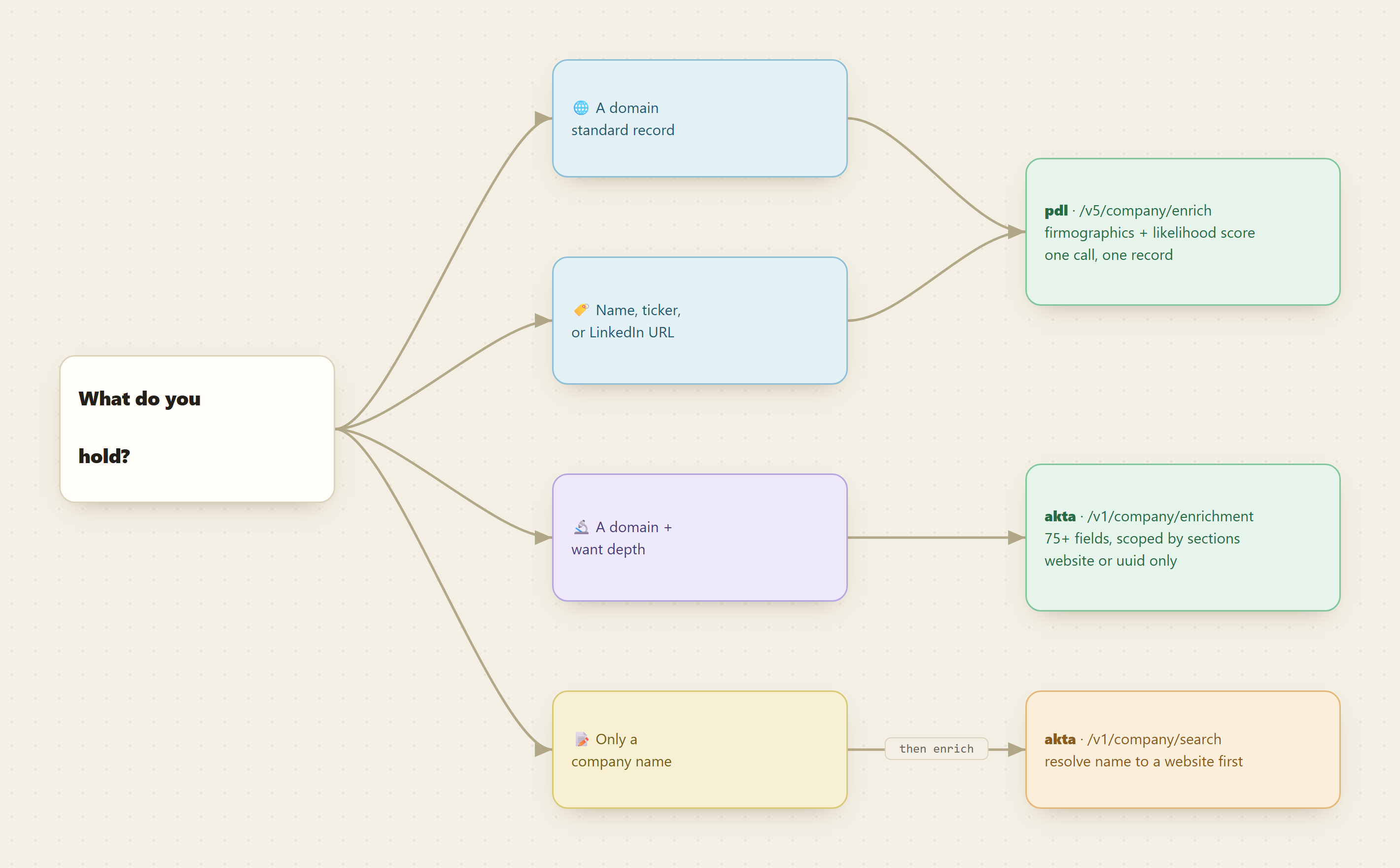
Which endpoint I reach for
| What I have | What I call | Why |
|---|---|---|
| A domain, want the standard record | pdl /v5/company/enrich | one call, one record, likelihood score |
| A name, ticker, or LinkedIn URL | pdl /v5/company/enrich | matches on identifiers beyond the domain |
| A domain, want depth (traffic, financial estimates, tech) | akta /v1/company/enrichment | 75+ fields, scoped by sections |
| Only a company name, want Akta depth | akta /v1/company/search, then enrichment | Akta needs a website or uuid |
📖 See also detecting a website's tech stack in one call
What a batch actually costs me
Both endpoints price in the cents range per company, with the exact number shown by monid inspect before you run and listed at monid.ai/tools. In practice, enriching a few hundred domains before an outreach push lands in the low tens of dollars, and a quick check of a dozen companies is pocket change. The part that changed my behavior is not the per-call price, it is the zero. In a month where I run nothing, I pay nothing, and I never again ended a quarter staring at expired credits.
Because Monid also ships as an MCP server, my agent does the same job without me. Handed a spreadsheet of domains, it searches the catalog, reads the two schemas above, picks PDL for the standard records, and escalates to Akta sections only for the shortlist. Free discovery plus visible prices is what makes that delegation safe.
FAQ
Do I need People Data Labs and Akta accounts? No. You integrate Monid once and fund one pay-as-you-go balance. Both vendors are called through the same key, and the wallet bills at the price shown before the run.
What happens when a domain does not match a company?
PDL attaches a likelihood score to every match, and min_likelihood lets you refuse low-confidence matches up front. Start at 4 for CRM-bound data and inspect anything that comes back below 6.
Is this a drop-in Clearbit replacement? It is a replacement for the job, not a mirror of the data. Coverage differs by vendor, so test with twenty domains you know well before pointing a pipeline at it. That test costs pocket change through monid.ai.
Can I enrich people too, not just companies?
Yes. PDL's /v5/person/enrich lives in the same catalog and takes an email, phone, name plus company, or LinkedIn URL. Same wallet, same workflow.
If your bill looks like mine did
Pull up your enrichment invoice and your actual call volume for the last three months. If the line is flat between spikes, you are paying for the flat parts. Search the catalog, inspect the two endpoints above, and run your next batch pay-per-call at monid.ai.