How to Give Atomic Agent Live Web Data with Monid
Connect a local Atomic Agent to live search and social data with one key, then read what two real calls returned: the rows, the fields and the time.

Let your local agent search the web and read Reddit with one key. Paste this into Atomic Agent:
Set up https://monid.ai/SKILL.md, and then use Monid to run a Google search for "local ai agent open source" with mrscraper /serp/google and a Reddit search for the top posts this month in r/LocalLLaMA about agents with anyapi /reddit.search. Show me the five search results as a table, the ten highest-scoring posts with score and comment count, and what each call cost.
One prompt, two live sources. 1 min setup · 3-6 hrs saved.
If you run an agent on your own machine, you already know the trade. The model is private and the tokens are free, and the moment you ask about anything that happened this week the answer is a guess. A local model knows what it was trained on. It does not know what ranks on Google today or what a subreddit argued about last night.
The usual fixes each stop short. A built-in search tool gets one page at a time and tends to wander. A dedicated server per source means a signup, a key and a config entry for every one: Atomic Agent's MCP Servers docs list seven official servers, and search, Reddit, lead and SEO data are not among them. Writing the scrapers yourself is a second project.
This guide ends with an Atomic Agent session that returns two things: a Google results table for a query and the month's top posts from one subreddit, both as structured rows. The data comes through Monid, the OpenRouter for agent tools: one key, one balance, every tool priced per call. Atomic Bot, the team behind Atomic Agent, is a content partner on this guide; the measurements are ours. Here is what the two calls returned on November 16, 2026.
| Measurement | Value |
|---|---|
| Google search, one query | 5 organic rows, 22.0 s, $0.001 |
| Fields on each search row | title, link, description, source, rank |
| Extra blocks in the same response | AI Mode summary with 4 sections, 6 navigation tabs, pagination to page 9 |
| Reddit search, scoped to one subreddit | 25 posts, 2.9 s, $0.00035 |
| Score range of those 25 posts | 294 to 1,961, median 528 |
| The same search without a subreddit | 25 posts, mostly off topic, same price |
| Spend for all three calls, Verified 2026-11-16 | $0.0017 |
Why a local agent needs live data before it answers
A local model answers from memory, and memory has a date. Ask it which open-source agents people recommend and it lists what was popular when its weights were frozen. Ask it what a competitor shipped on Friday and it either refuses or invents something plausible.
Live data changes what the agent is for. With a search call it can check a claim before repeating it. With a social call it can tell you what practitioners are saying this month, with scores attached, so you can separate one loud post from a pattern. The model still runs on your hardware; only the lookups leave the machine, and you see each one before it runs.
That last part matters for a local-first setup. Atomic Agent's documentation is direct about it: its web tools reach the open internet and anything they send leaves your machine. A data call is the same kind of event, so treat it as one: know which calls go out, and keep them few.
The 3 ways to give a local agent web data
Three routes, and they differ in how many accounts you end up holding.
The built-in web tools
Atomic Agent ships os.web.search and os.web.fetch, plus a browser family (browser.navigate, browser.search, browser.read_aria and others) that drives a Chrome, Edge or Chromium you already have installed. They need no key and no account. They return pages, so the agent reads and summarises one page at a time, and the docs call the web tools wandering-prone, with a loop detector that can end the turn. This is the right route for one lookup or one page.
One MCP server per source
Atomic Agent is an MCP client: add a server to mcp.servers in its config.json and the server's tools appear in the agent's toolbox under that server's name. Its docs walk through Linear, Sentry, Stripe, Grafana, Chrome DevTools, AWS and Zapier. This is the right route when the agent lives inside one product. For data it scales badly: every source is another vendor account, another key in the config and another server to keep running. Our guide to a web scraping MCP server covers that shape, and MCP vs API for AI agents covers when a tool should be a server at all.
Monid
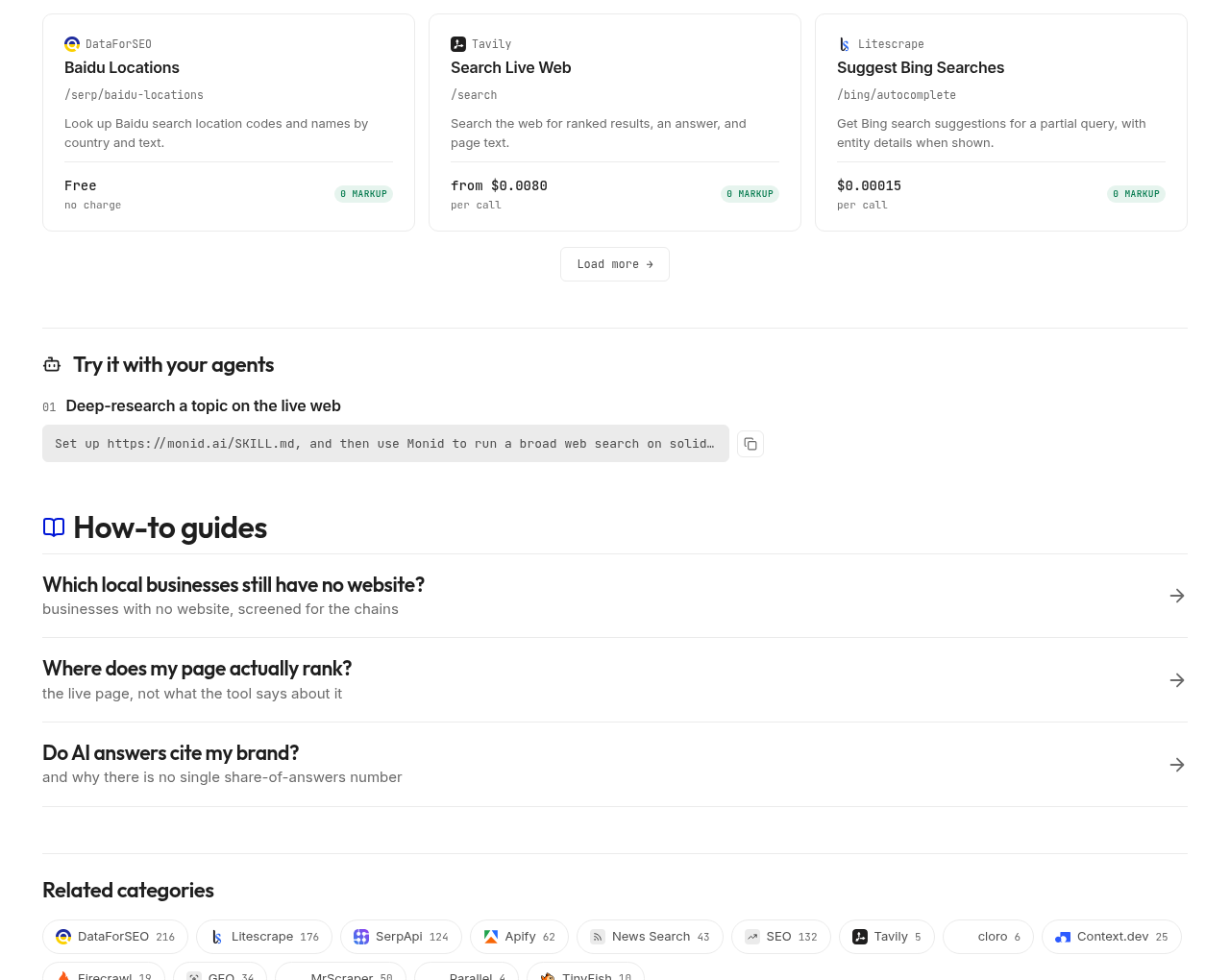
One key reaches the web search tools on monid.ai/tools, the Reddit and social cards, lead enrichment and SEO data, priced per call from one balance. The agent looks up the tool it needs at run time, reads its price, and runs it. Nothing is installed per source. Atomic Agent also has a Monid connector on the way, documented with its other servers on the MCP Servers page; the steps below use the route that works in any agent that can run a command.
| Route | How it bills | Fits | Limit to account for |
|---|---|---|---|
| Monid | Per call, from one balance; search $0.001, Reddit search $0.00035 (Verified 2026-11-16) | A local agent that needs several kinds of live data | Each call leaves your machine and goes through an approval |
| Built-in web tools | Free | One page or one lookup | Returns pages, one at a time; prone to wandering |
| One MCP server per source | Each vendor's own plan | An agent that works inside one product | A signup, a key and a config entry per source |
How to connect Atomic Agent to Monid
Four steps: install, add your key, run the search, run the Reddit call. An endpoint is the single operation you pick, here one search call and one Reddit call.
Step 1. Install Atomic Agent
Skip this if it is already on your machine. The installer covers macOS on Apple Silicon and Linux; Windows has its own PowerShell line on the installation page.
curl -fsSL https://atomicagent.io/install | sh
atomic-agent
The first launch opens a setup flow that picks and downloads a model, or connects a cloud provider or your own server. Atomic Agent is MIT licensed and its source is on GitHub.
Step 2. Add your Monid key
For agents. Get an API key at app.monid.ai, then give Atomic Agent the key and this setup line. The agent quickstart explains the workflow.
set up https://monid.ai/SKILL.md
For humans. Install the CLI and save your key locally. The CLI quickstart covers the rest.
npm install -g @monid-ai/cli
monid keys add -k <your-api-key> -l main
Either way the agent ends up calling the monid command through its shell tool, os.shell.run. At the default approval level Atomic Agent asks before each of those commands, which is the behaviour you want while you are learning what a call costs.
Step 3. Run a Google search
One query in, a results page out as JSON. Set the region and language so the results match the market you care about.
monid run -p mrscraper -e /serp/google \
  -i '{"query":"local ai agent open source","region":"us","language":"en"}' \
  -w -j
On November 16, 2026 this call completed in 22.0 seconds and returned 5 organic rows, each with title, link, description, source and rank. The card on the MrScraper page lists $0.001 per call, Verified 2026-11-16. Twenty seconds is slow next to a cached search API; the call loads the live page, and that is what you are paying for.
Step 4. Read a subreddit
Scope the search to one community with subreddit: inside the query, and sort by top for the month.
monid run -p anyapi -e /reddit.search \
  -i '{"query":"subreddit:LocalLLaMA agent","sort":"top","timeframe":"month"}' \
  -w -j
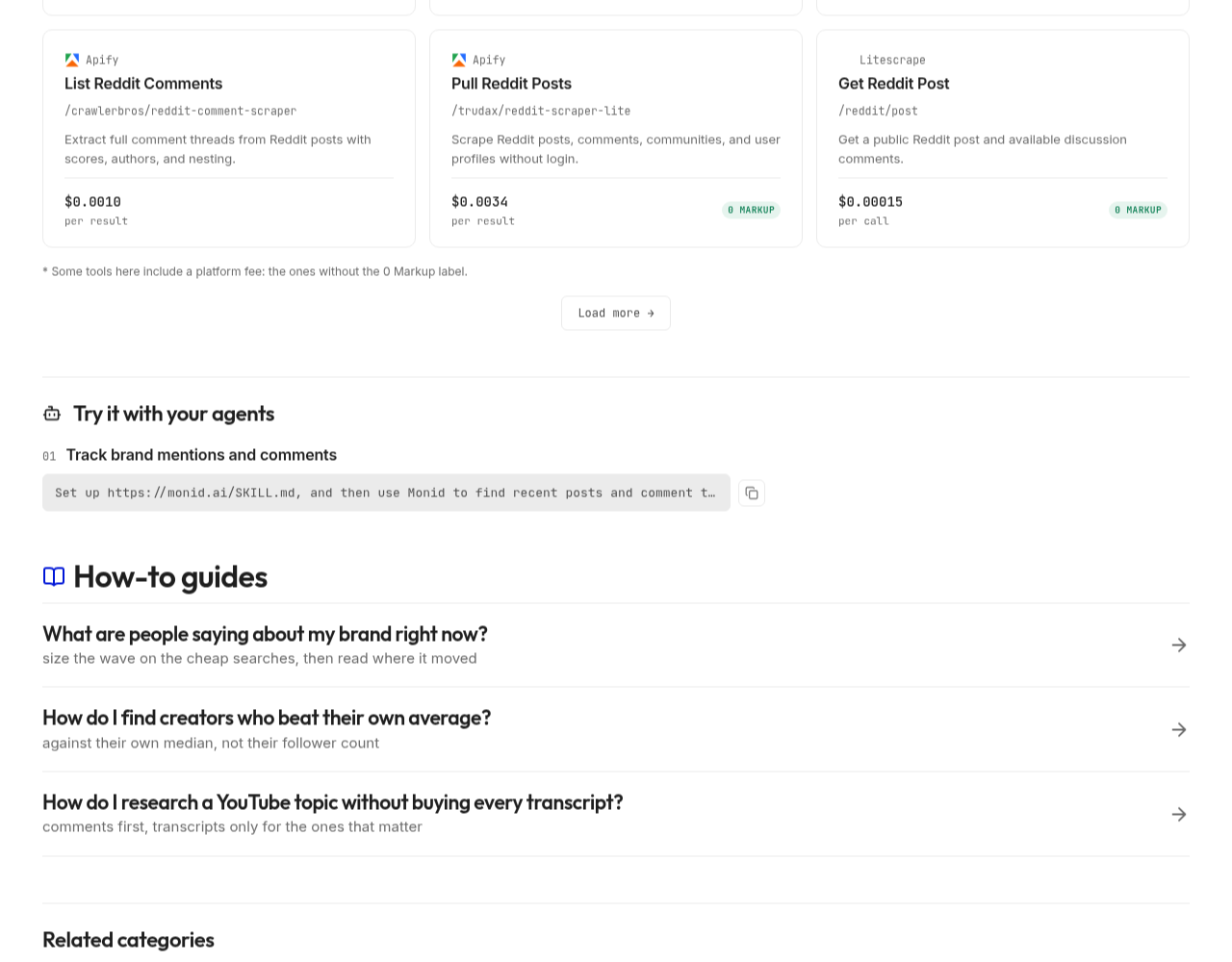
This returned 25 posts in 2.9 seconds, every one from r/LocalLLaMA, with title, score, numComments, selftext, permalink and createdUtc on each row. The Reddit tools list the default route at $0.00035 per call, Verified 2026-11-16; three other routes cost more and return a few extra fields.
How do you read the results?
Read the search response as four blocks and the Reddit response as a ranked list with one trap. Everything below comes from the November 16 runs.
The organic rows are the part to keep
organic held five rows for our query, ranked 1 to 5. Each has the page title, the link, a description that often starts with the publish date, and the source site name. Hand the agent these five rows and ask it to open the two that match the task; do not ask it to summarise all five from the snippets.
The AI Mode block is a second opinion, not a source
The same response carried an ai_mode block: one summary sentence and four named sections. It arrived with an empty citations list. Treat it as a list of names to check against the organic rows, never as a finding the agent can quote.
An unscoped Reddit search returns the whole site
Our first Reddit call used the plain query local ai agent with no subreddit. It also returned 25 posts in under three seconds, and they came from more than a dozen communities: a game render, a parenting thread, a coffee shop sign. The median score was 7,217 because sorting by top across all of Reddit rewards size, not relevance. The scoped call returned 25 on-topic posts with a median score of 528. Both cost the same, so the rule is to always name the community. For comments and full threads, the Reddit scraper guide goes a level deeper.
Scores tell you which posts to read
In the scoped result the top post scored 1,961 and the lowest of the 25 scored 294, with a median of 141 comments. A local model has a small context window, so pass it the ten highest rows and the selftext of the two or three it picks, which 22 of the 25 posts carried. A nextCursor came back for the next page; pages can overlap, so de-duplicate by id.
How much does it cost?
The search is $0.001 per call, Verified 2026-11-16 against the web search tools page, and the Reddit search is $0.00035 per call on its default route. Our three calls cost $0.0017 in total. Looking up a tool and reading its price are free, so the agent can check a card on every task without spending anything.
Two billing rules matter more than the figures. Both calls bill per call, not per row, so the unscoped Reddit search that returned noise cost exactly what the useful one did: a vague query is paid for in full. And there is no plan underneath: you add a balance, each call draws from it, and an idle agent costs nothing. The model side of the bill is whatever you chose in Atomic Agent, which for a local model is your own hardware.
How do you do this in your own code?
Wrap the two calls in a script and let the agent run it, or schedule it and hand the agent the file.
monid run -p anyapi -e /reddit.search \
  -i '{"query":"subreddit:LocalLLaMA agent","sort":"top","timeframe":"week"}' -j
monid runs get -r <run-id> -o reddit-week.json
Three habits keep a local agent on track. Save each response to a file and point the agent at the file, so a long result does not flood a small context window. Leave Atomic Agent's approval level at its default until you trust the prompts, since every monid run is a paid command. And pass subreddit:, region and language every time; the defaults are the widest and noisiest settings.
Which endpoint for which job?
| Use case | Best endpoint | Why? |
|---|---|---|
| Check what ranks for a query today | mrscraper /serp/google | Tested 2026-11-16, 22.0 s, 5 organic rows plus AI Mode block; $0.001 per call, Verified 2026-11-16 |
| Read one community's top posts | anyapi /reddit.search | Tested 2026-11-16, 2.9 s, 25 posts with score and comments when scoped with subreddit:; $0.00035 per call on the default route, Verified 2026-11-16 |
| Search all of Reddit | anyapi /reddit.search | Tested 2026-11-16, 2.7 s, 25 posts across many communities, mostly off topic for a broad phrase; same price, Verified 2026-11-16 |
When should you use something else?
Use Atomic Agent's built-in web tools when one page or one lookup answers the question. They are free, they need no account, and for "open this URL and tell me what it says" a paid call adds nothing.
Use a vendor's own MCP server when the agent works inside that product. If the job is triaging Linear issues or reading Stripe events, the official server from Atomic Agent's docs is the direct line. You are reading the Monid blog, so weigh that; our post on the OpenRouter MCP server and the tool layer lays out where a connector like this fits beside a single-vendor server.
Stay offline when the task must not touch the network. A data call sends your query to a provider, and a local agent is often local for a reason.
Two limits are ours to state. The calls in this guide ran through Monid on November 16, 2026 from a client other than Atomic Agent; the Atomic Agent steps follow its documentation of that date, and its Monid connector was not yet published when we wrote this. And the search call took 22 seconds, which is too slow to sit inside a tight loop: run it once per task, not once per thought.
Conclusion
You now have a local agent that can look two things up instead of guessing them: what ranks for a query today, and what one community has been saying this month, each as rows the model can reason over. Keep the model on your machine, send out only the lookups you approve through Monid, and scope every query before you pay for it. The 3 to 6 hours saved is our estimate for finding, signing up for and wiring two separate data vendors into one agent; the setup line is a one-minute target from key to first call. What you keep is an agent whose answers carry today's date.
FAQ
What is Atomic Agent?
A local-first AI agent built by Atomic Bot. It runs on your own machine, serves open-weight models through llama.cpp, and is MIT licensed; cloud model providers are optional.
Do I need to write code?
No. The prompt at the top does both calls from the agent. The commands are there for developers who want the raw JSON.
Does my data stay local?
The model and your sessions do. Each data call sends its query to a provider through Monid, the same way Atomic Agent's own web tools reach the internet, and the agent asks before it runs one at the default approval level.
How much does a call cost?
The Google search was $0.001 and the Reddit search $0.00035 per call, Verified 2026-11-16. Both bill per call, so a noisy result costs the same as a good one.
Can I use the Monid MCP server instead of the CLI?
Monid runs an MCP server at https://mcp.monid.ai/v1, and Atomic Agent is an MCP client. Follow Atomic Agent's MCP Servers docs for its Monid connector; the CLI route in this guide needs only a key.
Which model should the agent run on?
Any model Atomic Agent supports. A small local model benefits most from saving results to a file and reading the top rows, since a full response can exceed its context window.
Can I run this on a schedule?
Yes. Put the two commands in a script, run it from cron, and point the agent at the saved files when you want the summary.
Published November 2026.