Agentic Commerce: The Store Builds Itself, Not the Market
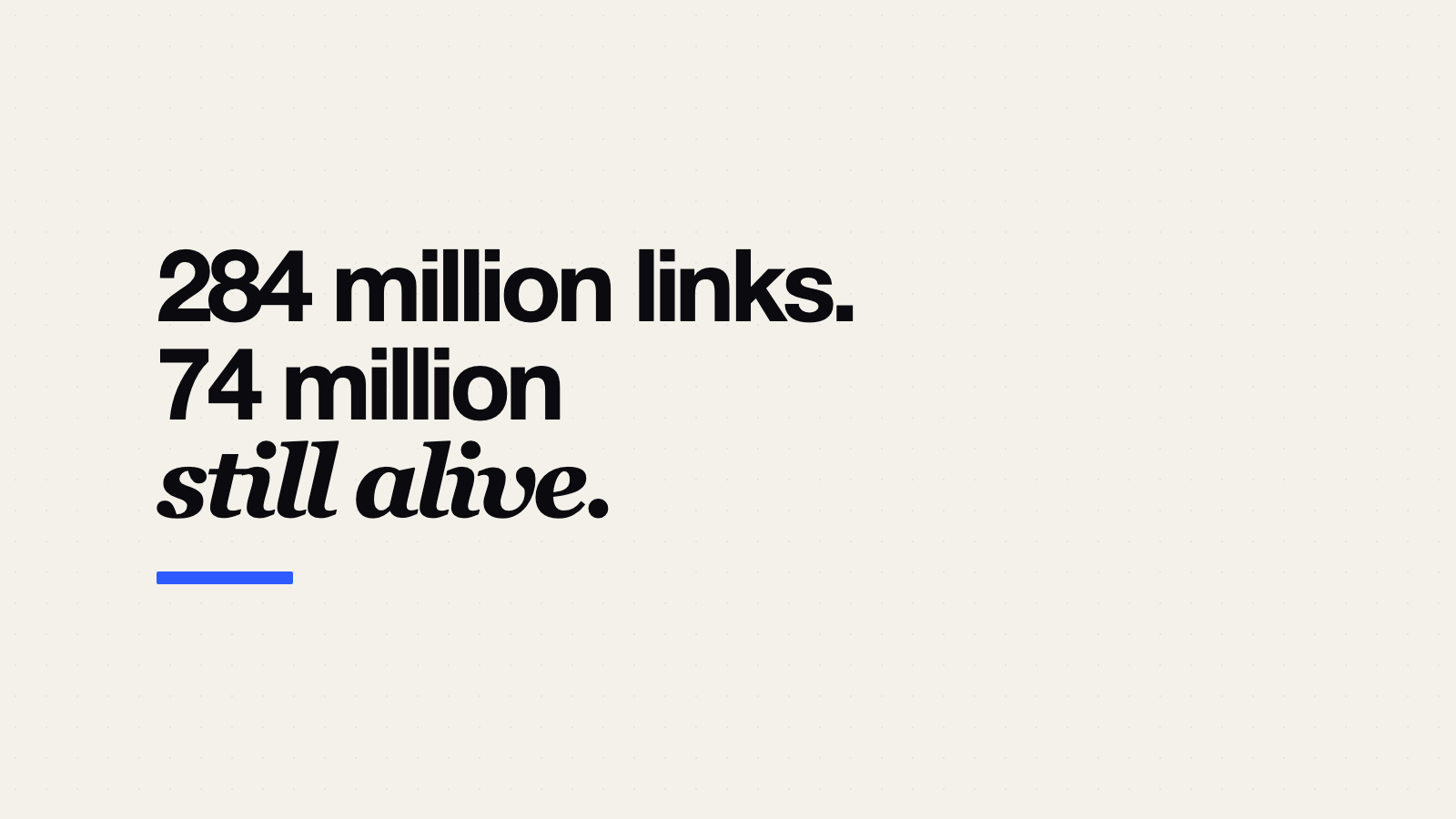
The hard part moved. Building a store is one sentence now. One call returned 48 competitors and an incumbent with 136,609 reviews.
An agentic commerce platform can now take one sentence and return a working store: products, payments, shipping, tax, live in minutes. Runner AI does this and then keeps going, running a team of specialist agents for ads, email, CRO, SEO, support and analytics, proposing the next move while the founder approves it.
Which raises the question that the demo never covers. The agent can build the store. How does it know whether the store is worth building?
That answer is not inside the store. It is one call away, and this is what came back for a single product idea:
"resistance bands set"          48 products, one call

price        $3.99  ->  $20.99 median  ->  $59.97
reviews         18  ->   2,646 median  ->  136,609
the leader   $8.98 with 136,609 reviews
the keyword  20,000 results deep
Fair disclosure. You are on the Monid blog, Monid sells the endpoint that returned those numbers, and Runner AI is a content partner. Runner AI is not in the Monid catalogue. The section near the end says when none of this data is worth fetching.
What is agentic commerce?
Software that runs a commercial operation end to end, deciding as well as executing.
The working definition
A normal ecommerce stack does what you tell it. An agentic one takes an objective, picks the actions, and reports back. In practice that means a set of specialist agents, one for ads, one for email, one for conversion, one for support, each holding a slice of the operation and proposing moves a human approves rather than authors.
The part people underrate is that the hard problem moved. Building the store was the bottleneck and is now a sentence. Deciding what the store should sell, and at what price, against whom, is the bottleneck now, and no agent can decide it from inside its own walls.
What the term covers and what it does not
It covers the operation: pricing, merchandising, campaigns, support, replenishment. It does not cover the checkout protocols that get discussed under the same banner, agents holding payment credentials and buying on a person's behalf. That is a related and separate problem, and conflating the two is why the phrase means three things depending on who said it.
Why outside data is the binding constraint
Everything an agent needs to run the store it already has. Everything it needs to decide what the store should be is a fact about other people's stores, and the rest of this guide is a measurement of exactly that gap.
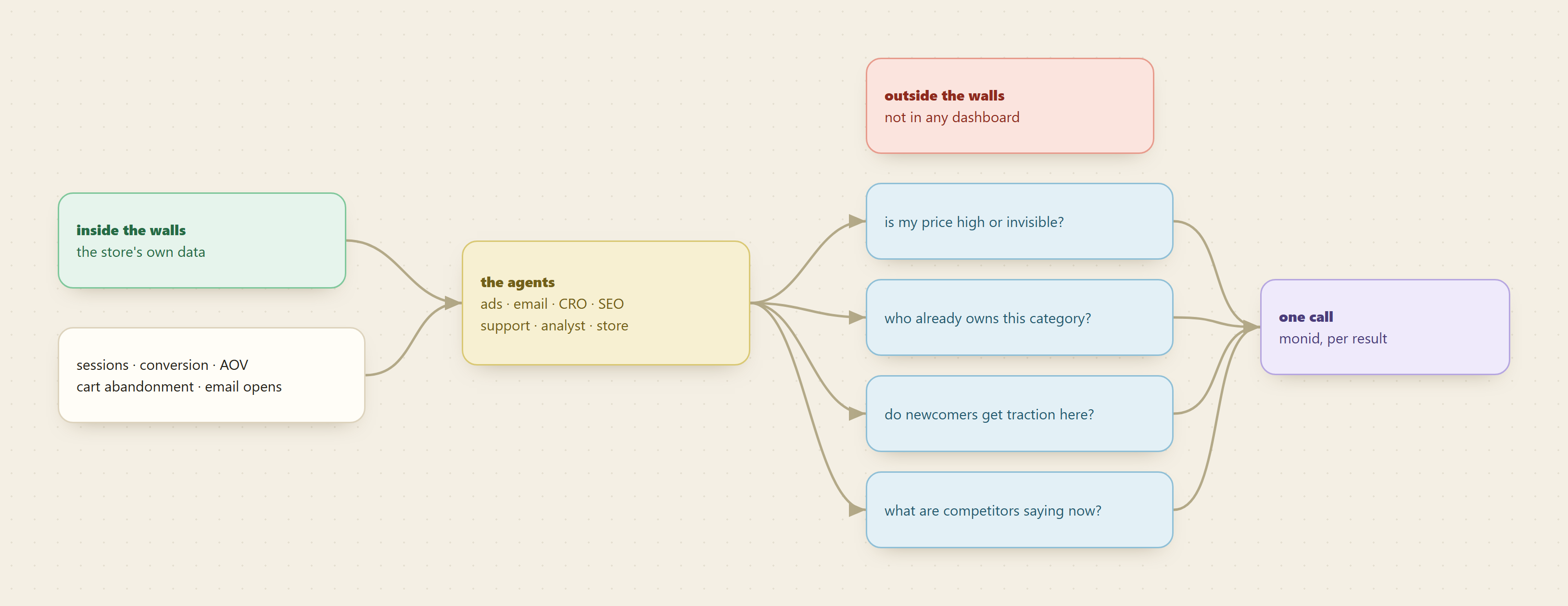
What can an autonomous store agent see, and what can it not?
It sees everything that happened inside its own walls, in perfect detail, and nothing outside them.
An analytics agent reading a live store knows sessions, conversion rate, average order value, cart abandonment, which product page leaks, which email got opened. That is genuinely a lot, and for a store that already has traffic it is enough to run a competent optimisation loop. A CRO agent that can measure its own funnel does not need anybody's permission to improve it.
Now list what that same agent cannot know at any resolution:
- Whether its price is high, low or invisible against the field
- Who already owns the category and how entrenched they are
- Whether new entrants are getting traction or bouncing off
- What competitors are actually saying in their ads right now
- Which adjacent search terms have demand it is not serving
Every one of those is a fact about the world, not about the store. No amount of instrumentation surfaces them, because the events never touch your servers.
And they are the expensive decisions. Tuning a checkout flow moves a few percent. Choosing the wrong category to enter wastes the whole quarter, and it is the decision an autonomous platform makes first, fastest, and with the least evidence.
What does the market look like before you enter it?
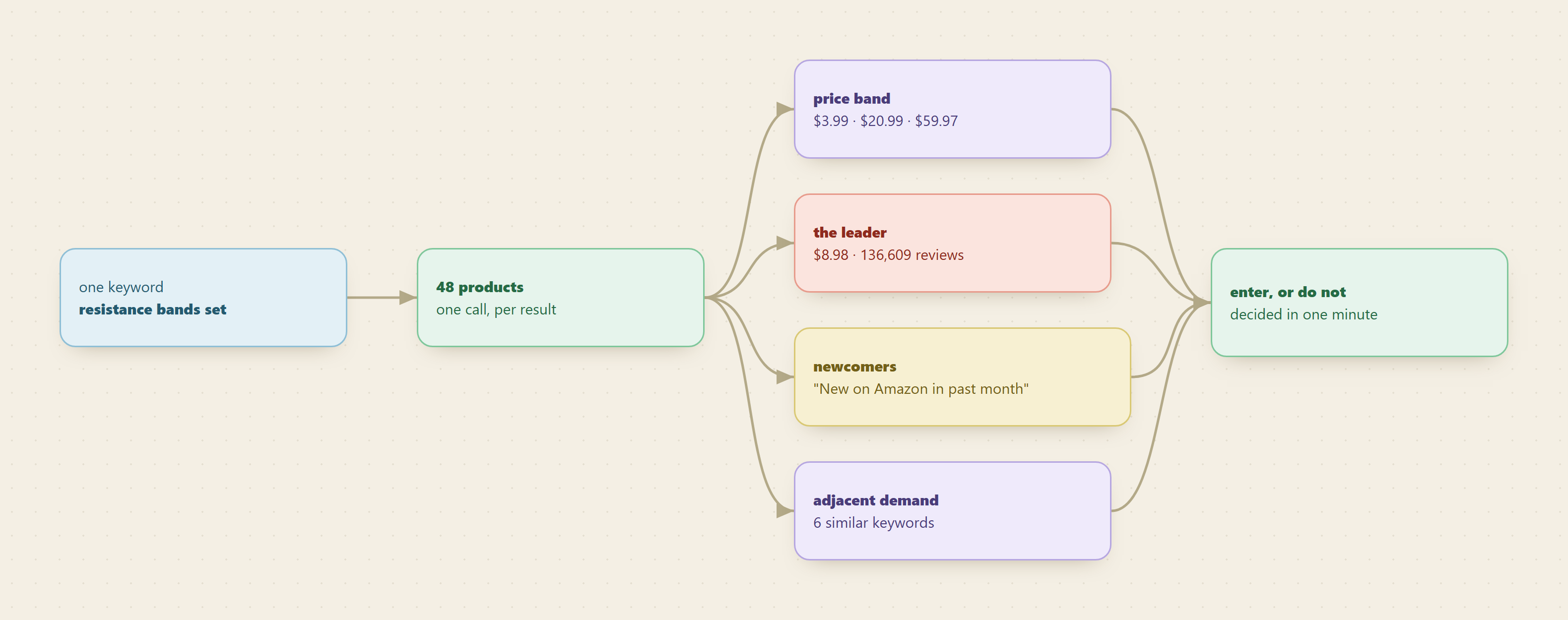
One call, forty eight competitors, and a decision that makes itself.
monid run -p apify -e /axesso_data/amazon-search-scraper \
  -i '{"input":[{"domainCode":"com","keyword":"resistance bands set","numPages":1,"sortBy":"relevanceblender"}]}' \
  -w -o market.json
Forty eight products came back. Read them in the order an agent would.
The price band is wide and the bottom is defended. Prices run $3.99 to $59.97 with a median of $20.99. That spread alone says the category is not one product, it is at least two: cheap loop bands and handled sets. Those are different buyers and different margins, and a platform that reads "resistance bands" as one market will price into the wrong half.
The leader is unassailable at the bottom. The most reviewed product is $8.98 with 136,609 reviews. There is no version of a new store winning that position. Any plan that involves competing on price against loop bands is already over, and the agent should know that before it writes a single line of copy.
The middle is a different story. The median product carries 2,646 reviews, and the handled sets clustering around $21 to $28 have review counts in the twenty to thirty thousands rather than the hundred thousands. Two orders of magnitude less entrenched.
And newcomers do get in. Every one of the 48 rows carried a salesVolume field, with values like 20K+ bought in past month and, on products inside the same top page, New on Amazon in past month. The category admits new entrants. Just not at the bottom.
The keyword itself is deep. resultCount came back as 20,000 for this term. Competing for it head on means arriving twenty thousand results late.
The adjacent terms are the actual opening
similarKeywords returned six phrasings alongside the main one, and reading them together says more than any of them says alone:
resistance bands for working out
resistance bands for working out womens
resistance bands for working out men
resistance bands for stretching
exercise bands resistance bands set
pull up assistance bands
Three of the six segment by audience, two by use case, one is a synonym. That is the shape of every entrenched category: the head term belongs to the incumbent, and the demand that is still available has already sorted itself into who is buying and what for.
A store agent handed only "resistance bands set" builds a general store into a wall. The same agent handed this list can build for one of those segments, which is a narrower store, a cheaper ad buy, and copy that says something. The list arrived in the same response as the price band, at no extra charge, and it is the field most people never read.
The full endpoint set for this kind of work sits under ecommerce on Monid and Amazon specifically.
That is a market entry brief, assembled from one request, in the time it takes to run it. The store builder cannot produce it, because none of it is in the store.
We have written the mechanics of this call up separately, in connecting an assistant to Amazon search data and in tracking rank on a schedule, so this piece stays on what the numbers mean rather than how to fetch them.
Give this to your agent
Set up https://monid.ai/SKILL.md, and then use Monid to search Amazon for my product keyword, then tell me the price range, the review count of the leader, and which adjacent keywords have demand.Which agent needs which outside source?
Each specialist has exactly one blind spot, and they are not the same blind spot.
| Specialist | Blind without | Where it comes from | Billing shape |
|---|---|---|---|
| Store | Price band, entrenchment, category depth | Marketplace search | Per result |
| Analyst | Competitor movement over time | The same search, repeated | Per result, per run |
| Creative | What buyers actually complain about | Reviews on the leaders | Per result |
| Ads | What competitors are running right now | Ad archives | Per call |
| SEO | What ranks and for which phrasings | Search results, adjacent terms | Per call |
| Support | Nothing external | The store's own data | Free |
Read the last row before the others. Not every agent needs outside data, and a piece written by a company that sells outside data should say so in the table rather than in a footnote.
The interesting column is the one on the right. A Store agent pulling a category once at launch is a single per result charge. An Analyst agent re-running it weekly is that charge on a schedule. An Ads agent watching competitor creatives is per call and flat, so it can poll hourly for the same money. Those are different cost curves, and if you are wiring these yourself, the shape decides your architecture more than the price does.
The reviews line is worth expanding because it is the one people skip. The leaders in this category have 136,609 and 36,420 reviews between them, which is an enormous corpus of buyers saying precisely what is wrong with the incumbent products. That is the Creative agent's brief, written by the market. We pulled that thread in reading 10,000 Amazon reviews and compared the endpoints in the reviews API guide. For the ads side, the Meta Ad Library as a feed covers what competitors are actually running.
This is the division the partnership sits on, and it is a clean one. Runner AI is the orchestration: the central intelligence that reads the business, proposes the highest-impact move, and summons the specialist to execute it while the founder approves. Monid is the tool layer those specialists reach through, one key and one balance for every outside source, billed per call. Neither replaces the other, and the reason to write this down is that most descriptions of agentic commerce quietly assume the data is already there.
What does feeding the agents cost?
Less than being wrong about the category, and the shape matters more than the number.
The search endpoint above bills per result, so the 48 rows are 48 units and a market brief lands in small change. That is per launch, and per re-check. An Ads agent watching an archive bills per call, flat, so its cost tracks how often it looks rather than how much it finds. Current magnitudes live on monid.ai/tools, because a figure written into an article goes stale quietly.
Runner AI's own pricing is a flat monthly plan with a free tier, which their reference pack contrasts against the five figures a month an equivalent human team of ads, email, CRO, SEO, support, analyst, ops and creative would cost. We are not going to reprint their number here for the same reason we do not print ours, but the shape of the argument is the point: the specialists got cheap, and the data they consume did too, and neither of those was true two years ago.
The general case for paying per call rather than a subscription covers why this suits agent workloads specifically: an agent that carries a whole catalogue and pays only for what it calls can afford to check things a human team would have skipped.
When does an agent not need outside data?
Four cases, and they are more common than a data vendor would like.
When the store already has traffic. A CRO agent optimising a funnel with real sessions has better evidence than any competitor scrape. Your own conversion data beats inference about somebody else's. Fetch outside data for entry decisions, not for optimisation ones.
When the category is one you already know. If you have sold in this space for five years, a price band read from a search page tells you nothing you had not priced in. The value here is highest exactly where the agent is least informed, which is a new category.
When the decision is small. Checking a competitor's price before changing a product title is effort spent on a reversible choice. Reserve the research for the decisions that are expensive to undo, which is mostly what to sell and to whom.
When the data does not exist for your model. Booking-based services, digital products and subscriptions are all things an agentic platform can run, and none of them have a marketplace search page to read. The method in this article is marketplace shaped, and outside that shape it degrades to ordinary web research.
We sell the endpoints, so weigh that list accordingly. The honest summary is that outside data earns its place at two moments, entry and periodic re-check, and that an agent asking for it continuously is usually a design mistake rather than a diligent one.
Conclusion
Building the store stopped being the hard part. An agentic commerce platform will stand one up from a sentence, wire the payments, and put a team of specialists on it by the afternoon.
What did not get easier is knowing whether that store should exist. The category leader at $8.98 with 136,609 reviews is a fact about the world, and no dashboard, no matter how good the agents reading it are, contains it.
The rule worth keeping: an agent's judgment is bounded by what it can see, so buy it eyes before you buy it hands. One call, forty eight competitors, and the plan changes or it does not. Either way you found out in a minute rather than a quarter.
FAQ
Is my store's own analytics not enough for an AI agent?
It is enough for optimisation and not for entry. Your analytics describe what happened to your traffic, which is the right evidence for changing a page, a price or an email. They contain nothing about who else is in the category, what they charge, or how entrenched they are, and those are the facts that decide whether the category was the right one. Different decisions, different data.
How often should an agent refresh competitor data?
Once at entry, then on a cadence matched to how fast the thing moves. Price bands and entrenchment shift over months, so monthly is usually enough and weekly is generous. Ad creative changes weekly. Review volume creeps. Refreshing everything daily mostly buys you a bill, and the endpoints that bill per result punish it hardest.
What are the best web scraping APIs for AI agents?
There is no single best one, because the platforms are not one problem: marketplace search, ad archives and social each want different providers. The comparison is in the web scraping guide for agents, and the argument for reaching them through one integration rather than several is in the API marketplace guide.
How do I wire this into an agent rather than running it by hand?
Monid ships as an MCP server, so an agent discovers the endpoint, reads its schema and calls it inside a conversation, with the prices visible before it commits. That is the setup in which MCP server gives an agent live web data, and the model side of the same wiring is covered in a model is half an agent.
Last updated August 2026.