How to Use a Pelosi Stock Tracker for Research
Separate disclosed trades from current stock quotes, build a dated research table, and keep missing disclosure evidence out of your alerts.
Attach dated stock quotes to your disclosure research without inventing trades. Paste this into your agent:
Set up https://monid.ai/SKILL.md, and then use Monid to inspect congressional disclosure coverage and retrieve one current stock quote for a ticker I supply. Keep disclosure evidence separate from quote data. Do not infer Pelosi ownership from a ticker lookup. Ask before any disclosure call with setup-plus-result billing.
No 1 min setup or hrs saved estimate is claimed; neither was measured here.
Research analysts and newsletter editors using a Pelosi stock tracker need two timelines: when a transaction happened and when a quote was observed. Copying a symbol from a headline into a watchlist gives you a stock to examine, but no evidence of who traded it.
A quote page answers a price question. A disclosure answers a reported-transaction question. Combining them without keeping the original document and dates creates a research table that looks complete while its central claim has no source.
We'll use Monid, the OpenRouter for agent tools, for the quote-enrichment part and inspect its disclosure option. The finished example below contains two actual AAPL quote results; it contains no Pelosi transaction records. The matching tools cover quote retrieval and offer disclosure intake, but they do not establish current holdings or portfolio returns from a quote lookup.
- Start with a documented transaction or a clearly labelled research ticker.
- Attach a dated quote without replacing the original asset description.
- Export the evidence and observation layers separately.
| Preview dimension | StockAnalysis observation | MarketBeat observation |
|---|---|---|
| Research ticker | AAPL | AAPL |
| Current price in USD | 349.39 | 349.36 |
| Day change percent | 1.62 | 1.61 |
| Pelosi trade established by this call | No | No |
These observations came back on October 29, 2026. AAPL is a test input, not a claim about a disclosed position.
How to use a Pelosi stock tracker with Monid
Use Monid to attach market context to sourced research, while keeping the disclosure document as the authority for the transaction. An endpoint is a callable tool that takes a defined input and returns data; a successful quote request establishes a quote observation, not ownership.
Step 1. Install and add your key
For agents, get your key at app.monid.ai and give your agent the setup instruction below; keep the key out of shared documents. For humans, use the CLI setup commands in the developer section before making a paid request.
set up https://monid.ai/SKILL.md
Step 2. Give your agent the evidence boundaries
Supply a source document reference, the asset description copied from it, and the ticker you want researched; if you have only a ticker, label the row “research only.” Use this instruction to stop the agent from filling missing evidence with a plausible narrative:
For each supplied asset, preserve the source document and original asset description. Keep transaction date, filing date, and quote observation time in separate columns. If the document does not establish a field, leave it blank. Start with one research ticker, AAPL, and do not label it as a Pelosi trade.
The inspected congressional disclosure tool accepts member-name, symbol, and date filters. Its input schema allows Max_Results from 1 to 1000, with a default of 100; set a small limit when testing, and review its billing structure before authorizing it.
We inspected that tool without executing it because its setup-plus-result billing falls outside this article's test rules. No disclosure row from it appears in the example, and none of its advertised output is presented as a measured result.
Step 3. Retrieve one quote
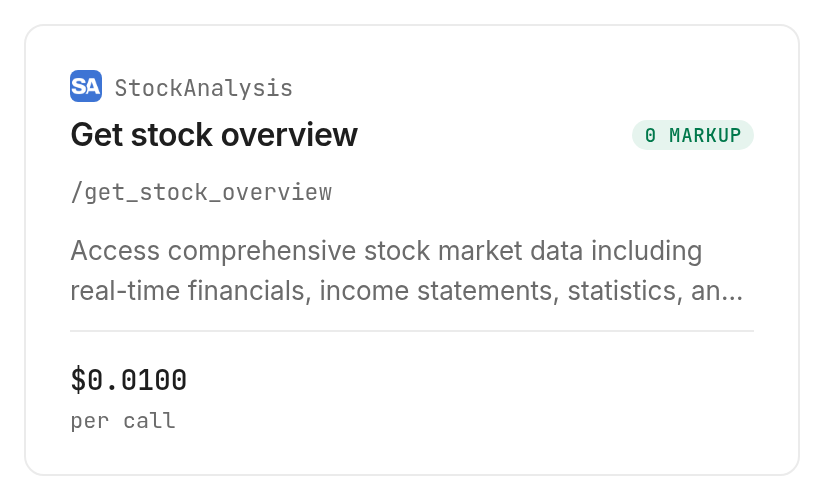
Ask your agent to call the StockAnalysis quote tool with symbol set to AAPL, then save the raw response and its observation time. Our single request completed successfully and returned one result in 7.103 seconds of processing time.
Step 4. Compare and export the observations
For an independent source column, ask your agent to retrieve the same ticker through the MarketBeat overview tool, with ticker set to AAPL and exchange set to NASDAQ. That request returned one successful result in 7.472 seconds; export these as separate observations rather than averaging them.
| Result dimension | StockAnalysis | MarketBeat |
|---|---|---|
| Input ticker | AAPL | AAPL |
| Price in USD | 349.39 | 349.36 |
| Day change percent | 1.62 | 1.61 |
| Volume as returned | 15000419 | 14.46 million shs |
| Market status | open | Not returned |
| Source quote time | Oct 29, 2026, 12:20 PM EDT | Not returned |
| Request completed at UTC | 16:20:55.877 | 16:21:02.551 |
| Result count | 1 | 1 |
The request completion time is processing metadata, not the provider's quote timestamp. Preserve that distinction in the export so a later reader can tell what each clock measures.
How do you read the results?
Read the table as market context for a research ticker, not as a list of disclosed purchases. The practical conclusion from these calls is that the quote layer works, while the disclosure layer still needs its own evidence before a transaction alert is justified.
Keep source values intact
StockAnalysis returned numeric p, cp, and v values; MarketBeat returned formatted strings for price, change, and volume. Save the original response alongside any normalized columns, because a rounded volume string does not carry the same precision as an integer count.
The two price observations differ by 0.03 in USD. That difference alone does not rank either source's accuracy: the requests completed at different times, and only one response included an explicit quote time.
Separate assets from positions
A ticker identifies a security for the quote request. It does not establish an owner's current quantity, purchase price, remaining position, or realized gain. A spreadsheet formula cannot recover those facts from a current-price field.
Keep a separate evidence status such as “source document attached” or “research only.” Those are your workflow labels, not fields returned by the quote tools, and your export should make that origin clear.
Add context without changing the claim
Company fundamentals answer a different question from a price snapshot. If your next step is examining revenue, ratios, or filings, follow the guide to stock fundamentals by ticker rather than treating a quote as a company analysis.
For an editorial watchlist, use three review queues: evidence missing, evidence attached, and ready for publication. This is an editorial recommendation: moving between queues should require a source check, not merely a refreshed price.
How much does it cost?
The two quote tools bill per call, and our two successful tests each billed one unit. The Monid catalog provides the current tool choices; discovery and inspection are free, while execution is the paid step.
The StockAnalysis overview costs $0.01 per call, Verified 2026-10-29. The MarketBeat overview costs $0.01 per call, Verified 2026-10-29.
Our measured total was $0.01 plus $0.01, Verified 2026-10-29. Both requests succeeded; no empty-result or failure-billing behavior was exercised by these tests.
Budget by unique ticker
Deduplicate your ticker list before refreshing prices. Several disclosure rows referencing the same ticker can share one dated quote observation, provided the export retains that shared observation's source and time.
Choose a maximum call count before starting a scheduled refresh. A second source doubles the number of quote requests for that refresh, so use it for review or comparison when the extra observation serves a specific purpose.
The inspected disclosure tool's billing combines a setup fee with transaction and stored-row charges. Verified 2026-10-29, these are $0.001 per setup, $0.001629 per transaction, and $0.00001 per stored row. These are inspected tier prices, not measured charges; we made no disclosure request.
How do you build the refresh in your own code?
Use the CLI's query parameters for these GET requests and store the returned run metadata with the output. Monid supplies discovery, inspection, and execution; your script supplies deduplication, storage, export, and scheduling.
Install the client
The standard human setup is:
npm install -g @monid-ai/cli
monid keys add -k <your-api-key> -l main
Keep credentials in the CLI configuration rather than a notebook or CSV. The CLI quickstart explains setup, while the agent quickstart covers delegating the workflow.
Discover and inspect before execution
These free commands show the available choices and the required query field:
monid discover -q "pelosi stock tracker" -l 8 -j --include-unavailable
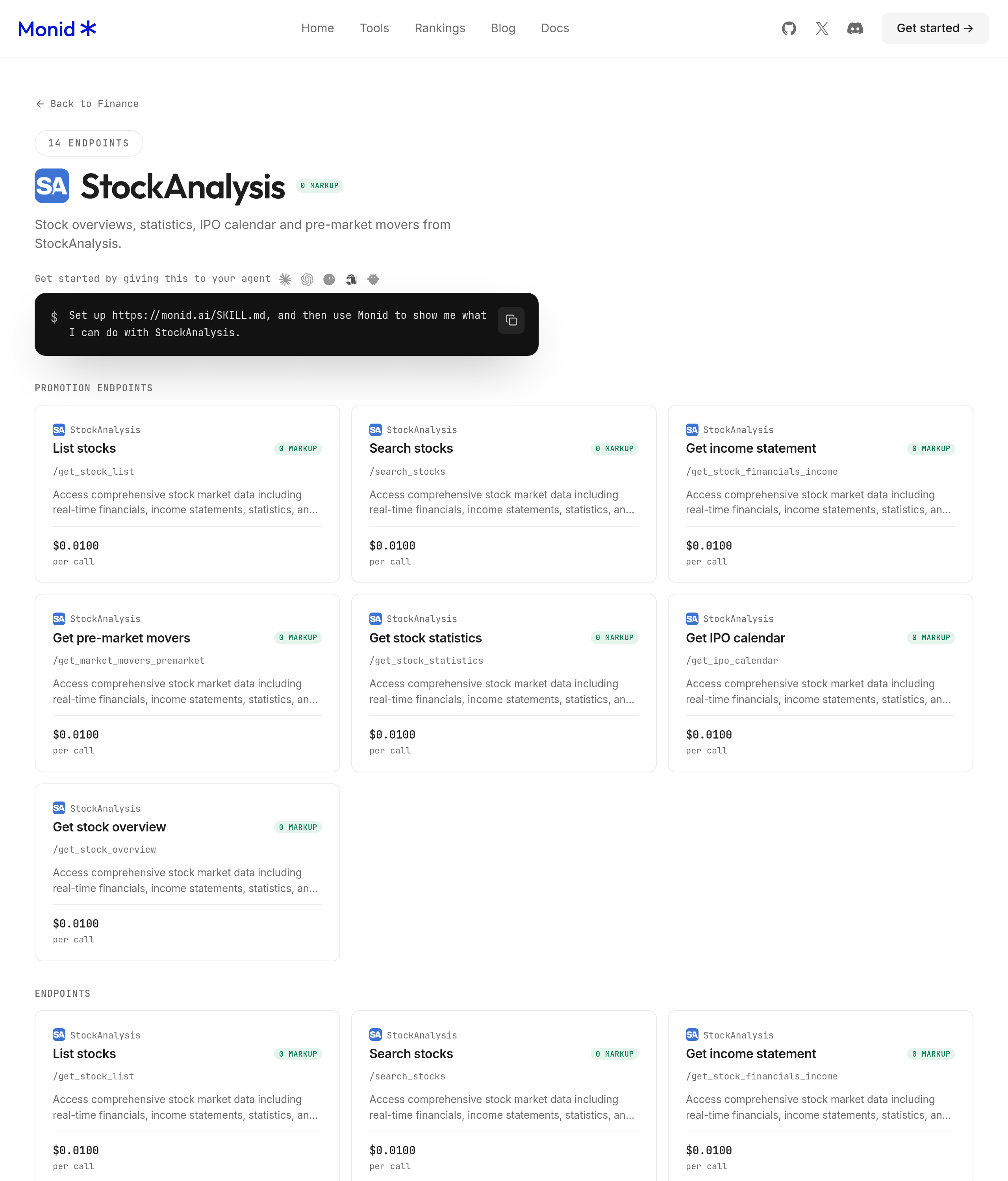
monid inspect -p stockanalysis -e /get_stock_overview -j
monid inspect -p marketbeat -e /get_stock_overview -j
The first tool expects symbol; the second expects ticker and accepts exchange. Treat each schema independently rather than passing one provider's parameter names to the other.
Execute the measured requests
These are the two commands used for the result table:
monid run -p stockanalysis -e /get_stock_overview \
  --query '{"symbol":"AAPL"}' -w -j
monid run -p marketbeat -e /get_stock_overview \
  --query '{"ticker":"AAPL","exchange":"NASDAQ"}' -w -j
Read quote values inside output.data, and retain runId, status, completedAt, resultCount, and cost from the enclosing response. Keep missing source timestamps blank rather than substituting the request completion time into the same field.
Store original responses before transforming them into a spreadsheet. A normalized number should remain traceable to the provider value, input ticker, and request that produced it.
When should you use something else?
Use original filings when your task is proving what was disclosed, and use a portfolio system when your task is calculating positions or returns. You're reading the Monid blog: we provide access to tools, including third-party sources, and the quote workflow shown here delivers only part of a Pelosi tracker.
The House Clerk financial disclosure portal is the starting point for House financial disclosure documents. Retain the document reference in your research notes so another reviewer can trace the transaction claim to its source.
The Apify congressional disclosure tool's documentation describes member, ticker, and date filtering, plus a direct scheduling workflow. Use that route when you want to manage that tool's tasks and schedules directly; its documentation describes capabilities, while this article demonstrates only the quote calls.
Company insider trading is another distinct dataset. The guide to insider trading and Form 4 data explains company insider transaction records, SEC filings, reporting owners, purchases and sales. Those corporate insider records do not replace congressional financial disclosures; choose the filing source for the person and transaction you are researching.
Neither successful quote request returned a transaction history. If your deliverable is “latest Pelosi trades,” stop at the evidence step until you have sourced transaction records; a current stock price cannot complete that deliverable.
Which tool fits each research job?
Choose by the evidence needed for the next column of your table. A tool that provides price context has a useful role without being the source of a trade claim.
| Use case | Best endpoint | Why? |
|---|---|---|
| Attach a numeric quote and source time | StockAnalysis overview | Tested once with AAPL; per call, Verified 2026-10-29: $0.01 |
| Compare a second price observation | MarketBeat overview | Tested once with AAPL; per call, Verified 2026-10-29: $0.01 |
| Inspect disclosure intake | Apify congressional disclosures | Inspect only; setup plus transactions and storage, Verified 2026-10-29: $0.001 setup + $0.001629 per transaction + $0.00001 per stored row |
Conclusion
You now have a repeatable way to add two sourced quote observations to a research ticker while preserving the gap between market context and disclosure evidence. Monid handles the tool calls; your research process must still attach and review the original transaction record. No setup-duration or hours-saved estimate was measured for this article. Keep the evidence and observation columns separate, and your next refresh will update prices without silently rewriting what the source document proves.
FAQ
Is a Pelosi stock tracker free?
Discovery and inspection through Monid are free; the quote calls shown here are paid per request. See the current quote tools for billing, and distinguish access to a document from paid enrichment of its tickers.
Does a stock quote prove Pelosi owns the stock?
No. A quote describes a security at an observation time. It contains no evidence of a particular owner's holdings or transactions.
Do I need to write code to make the table?
No. Give an agent the ticker and evidence boundaries in the opening prompt. Review its source references and keep missing disclosure fields blank before sharing the table.
How many stocks can I refresh at once?
The tested quote tools accept one ticker per request. Deduplicate the list, then authorize a bounded number of calls; the disclosure tool has a separate input limit and separate billing.
Can I schedule a Pelosi stock tracker?
You can schedule your own refresh script. These quote calls do not create a schedule or send alerts; store previous observations and define the notification rule in your application.
Are failed requests charged?
Both quote tests succeeded and each billed one call. This article establishes no failed-request billing rule; retain status and cost metadata so your own execution log records what happened.
Is it legal to reuse disclosure data?
Rules vary by location and use; check the requirements that apply to your project. Access to a tool does not decide how you can reuse the underlying information.
Published October 2026.