Apollo Scraper: Export Apollo.io Leads Safely by API in 2026
An Apollo scraper extension can get your account flagged. How to pull the same Apollo.io people and company data by metered API, with search free.

We do a lot of outbound, which means we pull a lot of Apollo data, and every few weeks someone on the team asks the same thing: "can we just grab an Apollo scraper to get more leads out?" The instinct is right, the tool most people reach for is wrong. Search "apollo scraper" and the first page is a wall of Chrome extensions that drive your own logged-in Apollo.io session to export past your plan's cap. They work until they do not, and when they stop it is usually because the account driving them got flagged.
So the real question behind "apollo scraper" is not "which extension," it is "how do I get Apollo.io people and company data out, at the volume I need, without putting an account at risk." There are two honest answers, and only one of them survives contact with scale. This guide lays out both, shows the free-then-metered API pattern that most people miss, and yes, you are on the Monid blog, so one of the two options is ours. We will be straight about when it is not the one you want.
An Apollo scraper that drives your logged-in session can bypass an export cap and get the account flagged in the same afternoon. The licensed Data API does the same job without betting your seat on it.
What does an "Apollo scraper" actually do?
Strip away the branding and there are two completely different tools wearing the same name. The first is a browser extension that automates the Apollo.io web app you are already signed into: it clicks through search results and copies rows faster than a human, which is how it slips past the export limits on your plan. The second is Apollo's own Data API, the licensed, documented channel Apollo sells for exactly this purpose, which returns the same records as structured JSON with no browser in the loop. They land in very different places on the risk and stability curve.
| Session-driving extension | Apollo Data API (metered on Monid) | |
|---|---|---|
| How it gets data | Automates your logged-in Apollo tab | Licensed API call, no account session |
| Account ban risk | Real: bypassing export caps violates the terms | None: this is the sanctioned data channel |
| Breaks when | Apollo changes its web UI | Rarely, the API contract is versioned |
| Ceiling | What your seat can see and export | Up to 50,000 records per search, paginated |
| Contact reveal | Whatever your plan already unlocked | Metered per person, only when you enrich |
| Cost shape | Extension fee plus your Apollo seat | Pay per call, zero when idle |
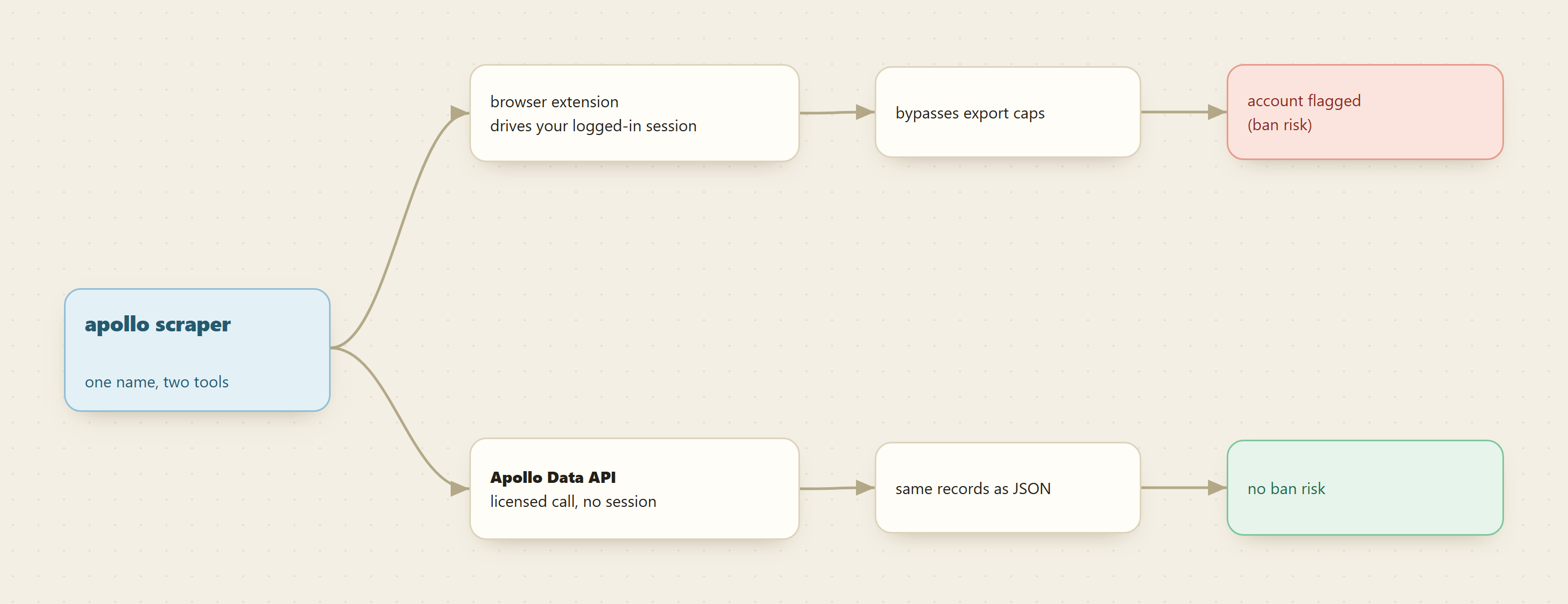
The extension route is not evil, it is just fragile. It is fine for a one-off pull inside limits you already pay for. The moment you want data programmatically, on a schedule, or fed to an agent, you are one UI change or one flagged account away from a dead pipeline. The API route is the one that scales, and it has a pricing shape that surprises people the first time they see it.
Why is Apollo search free and enrichment metered?
Here is the part that changes the economics. Apollo's people search and the enrichment that reveals contact data are two separate calls with two separate prices, and the first one costs nothing. You can filter Apollo's database of 230M plus people by title, seniority, location, employer, headcount, revenue, and the technologies a company runs, and paginate through the matches, without spending a cent or burning an Apollo credit. Search returns previews with a stable Apollo person id but no email and no phone. You only pay at the second step, when you hand an id or a name back to Apollo and ask it to reveal the verified contact.
That split is the whole trick to keeping an Apollo scraper cheap. You cast a wide, free net, the same move behind our ICP prospect search walkthrough, decide which people are actually worth contacting, and pay to enrich only those. Verify the schema first, which is also free, then run the search:
monid inspect -p apollo -e /mixed_people/api_search
monid run -p apollo -e /mixed_people/api_search --query '{"person_titles[]":["Head of Growth","VP Marketing"],"person_seniorities[]":["vp","head","director"],"organization_num_employees_ranges[]":["50,200"],"person_locations[]":["United States"],"per_page":25}' -w
Every filter above is optional and stackable. Titles match any one in the list, seniorities narrow the level, organization_num_employees_ranges scopes to company size in min,max string form, and there are filters for revenue, headquarters location, and even the technologies a target account uses. Each search page returns up to 100 records, and you can walk up to 500 pages, so one query fans out across a serious slice of a market. None of it bills.

When you have chosen who is worth reaching, enrich them one at a time. Pass any identifier you hold, an Apollo id from the search, a name plus company domain, or a LinkedIn URL, and more identifiers improve the match:
monid run -p apollo -e /people/match --query '{"name":"Jane Doe","domain":"acme.com"}' -w
The base enrich returns the verified work email, title, seniority, department, employment history, and current employer, the same one-identifier-in, full-profile-out move we lean on across enrichment. Two flags add depth only when you ask: reveal_personal_emails appends personal addresses, and reveal_phone_number returns a direct or mobile number. The phone path is worth understanding before you use it, because Apollo produces those numbers asynchronously. That run stays in a RUNNING state for several minutes while Apollo works, so you poll it rather than waiting inline, and it only charges the phone premium when a number actually comes back. A no-match consumes nothing.
Should I run it direct on Apollo, or metered on Monid?
This is the honest fork, and it is the real reason this page exists. This is Apollo's data through Apollo's API, and you can absolutely go direct. Apollo sells API access on its higher plans, and if Apollo is the spine of your go-to-market, you live in the product every day, and your volume is steady, buying their API seat and calling it straight is the right move. You get their console, their credit dashboard, and their support. We will not pretend a marketplace beats that for a heavy daily Apollo shop.
The friction is the same one that shows up with every data vendor: going direct means a plan with an API tier, a credit balance you top up in blocks, and a seat you pay for whether this month is busy or dead. That suits steady heavy use and chafes against the far more common shape, which is bursty. You want two thousand prospects enriched for one campaign, then nothing for six weeks. Paying a monthly floor to idle between campaigns is the cost that never makes it into the plan.
That bursty shape is what Monid is for. It is the OpenRouter for agent tools: one key and one balance reach over a thousand tools, Apollo's people and company APIs among them, with the price shown before anything runs and zero cost when idle. You do not hold an Apollo API seat or a credit block. Discovering an endpoint and reading its schema are free, so you can inspect the search and enrich calls, confirm the exact fields, and only pay when an enrich actually fires. Point an agent at it and it learns the whole discover, inspect, run loop on its own from set up https://monid.ai/SKILL.md. For a human, setup is two lines:
npm install -g @monid-ai/cli
monid keys add --label main --key <your-api-key>
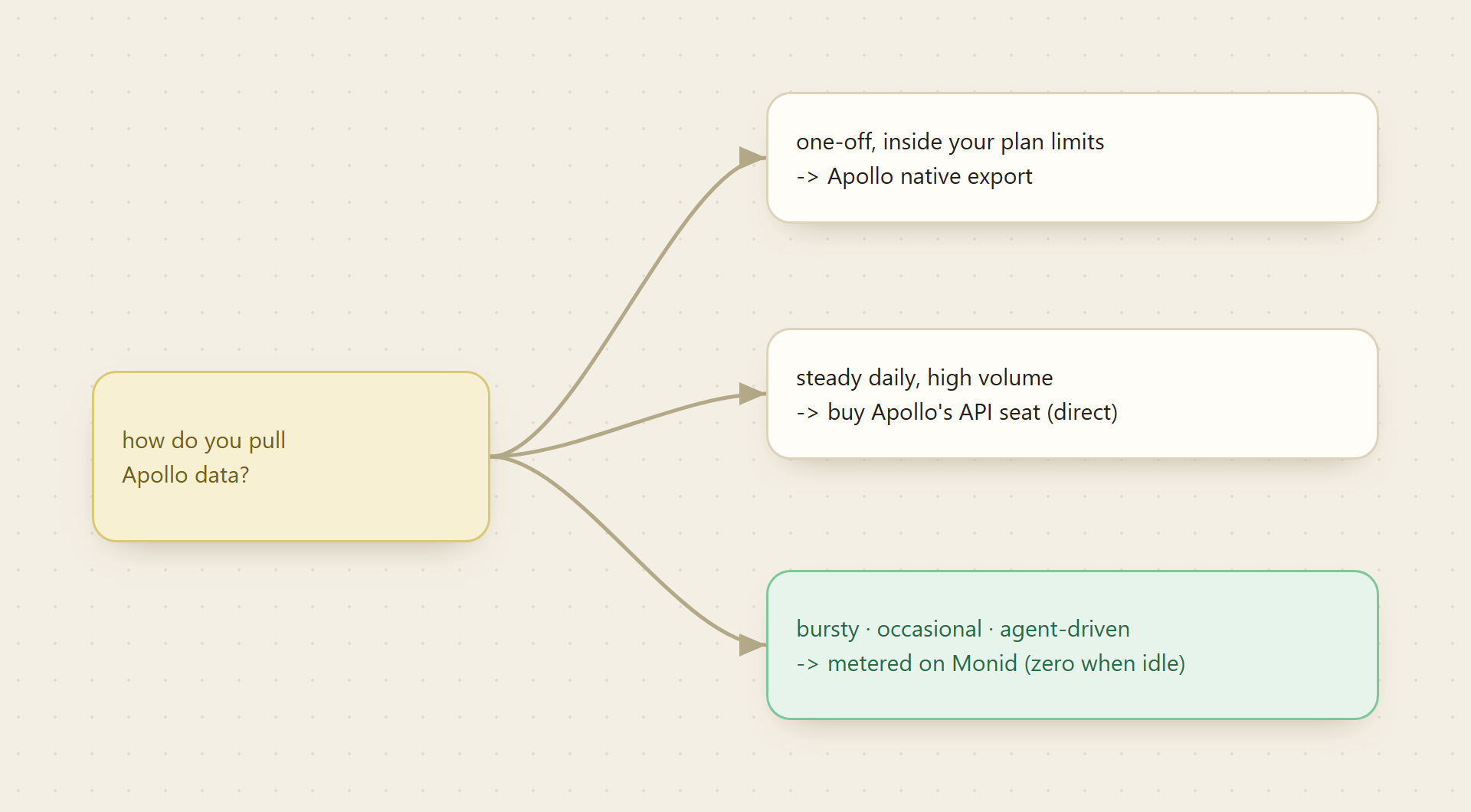
The short version: use Apollo's native export for a quick pull inside your limits, buy Apollo's API seat when Apollo data is a daily fixture at volume, and run the same search and enrich metered on Monid when your usage is spiky, occasional, or spread across an agent that would rather call one endpoint than manage a vendor account and a credit balance.
What does this cost, and where is the catch?
We do not print rates, because the number that matters is cost per usable contact and live magnitudes sit at monid.ai/tools. The reasoning that survives any price change: search costs nothing, so the wide part of the funnel is always free, and enrichment bills in the fraction-of-a-cent to low-cents range per person depending on whether you pull email only, add personal emails, or reveal a phone. Enrich a couple thousand chosen contacts and you are in the low tens of dollars for that campaign, dropping to zero the moment it ends. Direct on Apollo, the marginal cost per credit can be similar or lower, but it rides on top of a seat you pay for every month regardless. The crossover is volume: past a high, steady daily load the seat divided across contacts finally dips below the per-call price, and below that load metered wins.
The caveat that matters more than price: this route is clean precisely because it is Apollo's licensed data, so keep it that way. The Data API is meant for building your own prospecting and enrichment, not for cloning Apollo's database wholesale or reselling the raw records, and Apollo's terms draw that line clearly. Respect suppression and consent rules on the contacts you pull, honor regional privacy law when you reach out, and treat a verified email as permission to do research, not a licence to spam. The reason this beats a session-driving extension is not just that it survives a UI change, it is that it keeps you inside the terms instead of one policy sweep away from a banned account.
Which endpoint should I use for which job?
Everything above runs on a small set of Apollo endpoints, all reachable through one Monid key, and discovering or inspecting any of them is free so you can read the exact fields and price before you spend. The full set lives on the Apollo tools page, and the four that carry the lead workflow are these.
| Endpoint | What it does | Bills |
|---|---|---|
/mixed_people/api_search | Filter Apollo's 230M plus people by title, seniority, location, employer, headcount, and technology | Free |
/people/match | Reveal one person's verified work email, and optionally personal email or mobile phone | Metered per person |
/organizations/enrich | Enrich one company by domain with firmographics, funding, and tech stack | Metered per call |
/mixed_companies/search | Find companies by headcount, revenue, funding, location, and technology | Metered per call |
If the job runs wider than Apollo, the same balance reaches every provider in the lead-generation, people-enrichment, and company-enrichment categories, so you can cross-check a contact against a second source without signing a second contract. For more on how we use this data channel, see the Apollo on Monid overview.
Conclusion
The best Apollo scraper is not a scraper at all. It is the licensed search and enrich pattern: cast a wide free net over the people database, keep only the accounts worth reaching, and pay to reveal contact data one person at a time.
Two things matter more than which route you pick. The free half is the half that decides your cost, because every dollar you spend is a person you chose to reveal, and a sloppy filter is what turns a cheap campaign into an expensive one. And the ban risk is a licensing question, not a technical one: an extension driving your logged-in session is against Apollo's terms whether or not it works today, while the Data API is the sanctioned path and stays sanctioned through a UI change.
Start with the free part: /mixed_people/api_search costs nothing and returns person ids, so you can build and refine the whole target list before spending anything. Then reveal a handful, check the fill rate on the fields you actually need, and size the run from that. Begin at monid.ai.
FAQ
Is scraping Apollo.io safe?
A browser extension that drives your logged-in Apollo session to bypass export caps is the risky version, because it violates Apollo's terms and can get the account flagged. Pulling the same data through Apollo's licensed Data API, which is what runs behind the Monid endpoint, is the sanctioned path and carries no account-ban risk.
Do I need an Apollo account to use the API?
To go direct, yes, you need an Apollo plan with API access. Metered on Monid you do not: you integrate once, fund one pay-as-you-go balance, and the Apollo search and enrich calls run behind the endpoint with no separate Apollo seat or credit block.
Is Apollo people search really free?
Yes. The /mixed_people/api_search call filters Apollo's people database and returns previews with a person id at no cost and no Apollo credit. You only pay at /people/match, when you reveal a verified email or phone for a person you have chosen.
How is it billed?
Search is free. Enrichment bills per person and is shown before anything runs. Personal emails add a premium, a revealed mobile number adds a larger one and only when a number is actually found. Discovering and inspecting an endpoint on Monid are free, only the run bills your balance, and current magnitudes are at monid.ai/tools.
Last updated August 2026.