How to Use the Yelp API for Review Monitoring
Get Yelp reviews into your agent, compare a small sample across two providers, and build a repeatable review-monitoring table.
Get a small Yelp review sample into your agent and turn it into a monitoring table. Paste this into your agent:
Set up https://monid.ai/SKILL.md, and then use Monid to find coffee businesses in Austin, TX, select Mozart's Coffee Roasters, collect its three newest English Yelp reviews, and return a table with rating, review date and whether the owner replied. Keep reviewer identities out of the table and save the response as JSON. Stop after one search and one reviews call.
Planning estimates: 1 min setup · 1-2 hrs saved for a ten-business digest.
Developers searching for the Yelp API often start with a copy-and-paste review digest. That stops being a useful process when one business has 2,160 reviews in its listing, as the Austin coffee business in our sample did. You need a repeatable selection rule before you hand the text to an agent.
A spreadsheet records what you read, but it does not preserve the request that selected those reviews. A business rating also answers a different question from the ratings in its three newest reviews. Treating those two numbers as interchangeable produces a misleading digest.
We'll use Monid, the OpenRouter for agent tools, to collect a small review sample through one key and balance. The finished artifact is a table of ratings, dates and reply presence, backed by saved JSON. We'll collect it, interpret its scope, and define the boundary between fetching data and operating a scheduled monitor.
| Preview from the real sample | Result on 2026-11-12 |
|---|---|
| Reviews requested from each provider | 3 |
| Reviews returned from each provider | 3 |
| Ratings in newest-first order | 4, 5, 4 |
| Reviews with an owner reply | 3 of 3 |
How to use the Yelp API with Monid
Use Monid to discover the available calls, inspect their inputs, search for the business identifier, and request three reviews. An endpoint is a callable operation with its own input schema and billing rule; here, search and reviews are separate operations.
Step 1. Install and add your key
For agents: Get an API key at app.monid.ai, then give your agent the setup instruction and the key through its credential setup.
set up https://monid.ai/SKILL.md
For humans: Install the CLI and save your key using the template's commands; the CLI quickstart covers the setup.
npm install -g @monid-ai/cli
monid keys add -k <your-api-key> -l main
Step 2. Find the business you mean
Search once for coffee in Austin, sorted by review count, then choose the intended location from the returned businesses. This test returned ten organic businesses; use the selected row's encoded identifier from reviews_link.queryParams.place_id, rather than guessing from its readable URL.
monid discover -q "yelp api" -l 8 --include-unavailable -j
monid inspect -p serpapi -e /yelp/search
monid run -p serpapi -e /yelp/search \
  --query '{"find_loc":"Austin, TX","find_desc":"coffee","sortby":"review_count"}' -w -j
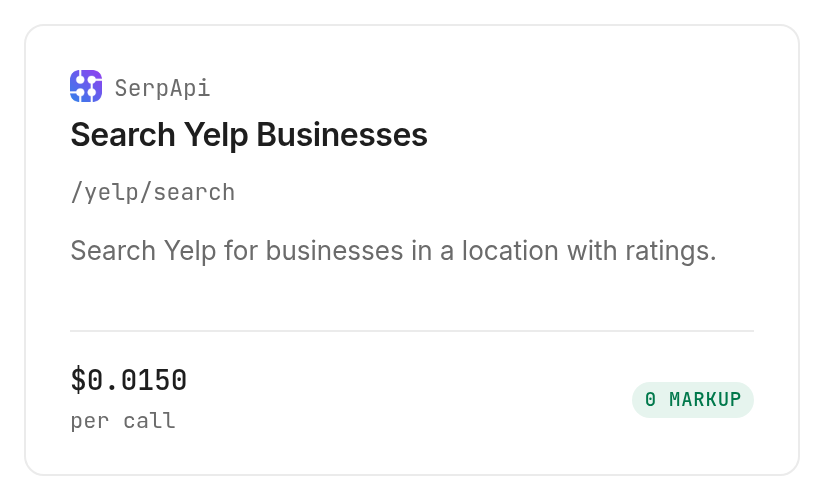
The SerpApi search call costs $0.015 per successful call, Verified 2026-11-12. The business name and street address let you confirm the location before spending on reviews.
Step 3. Collect a small recent sample
Inspect the SerpApi reviews call, then use num:3 to keep the first test small and date_desc to request newest-first order. Keep hl:en explicit so the saved request records the language selection.
monid inspect -p serpapi -e /yelp/reviews
monid run -p serpapi -e /yelp/reviews \
  --query '{"place_id":"-4ofMtrD7pSpZIX5pnDkig","num":3,"sortby":"date_desc","hl":"en"}' -w -j
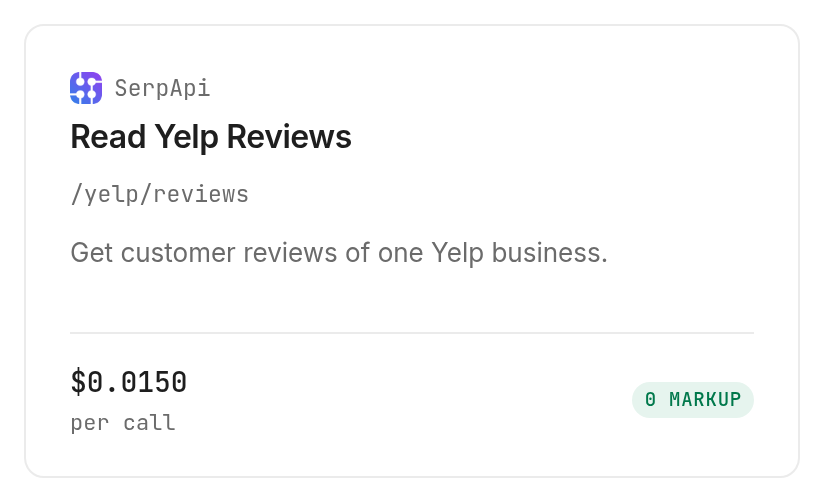
That call returned three reviews and reported one billed unit at $0.015, Verified 2026-11-12. Its run timestamps span 2.067 seconds; that is the duration of this observation, not a promised response time.
Step 4. Compare an alternate collection route
The Litescrape reviews call accepts the same business identifier and the same four inputs in this example. Inspect it separately rather than assuming every provider accepts interchangeable parameters.
monid inspect -p litescrape -e /yelp/reviews
monid run -p litescrape -e /yelp/reviews \
  --query '{"place_id":"-4ofMtrD7pSpZIX5pnDkig","num":3,"sortby":"date_desc","hl":"en"}' -w -j
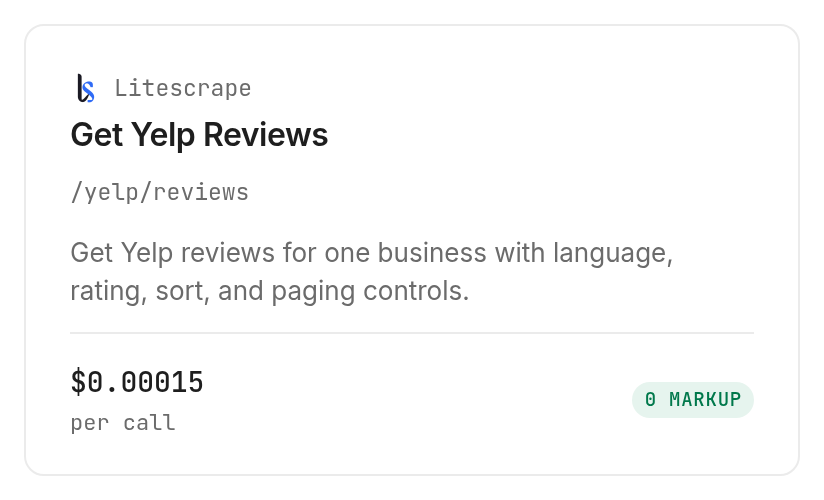
This call returned three reviews, reported one billed unit at $0.00015, Verified 2026-11-12, and completed in 1.551 seconds. The dates and ratings matched the other sample; that establishes agreement on these three rows, not independent corroboration of every Yelp review.
Why review scope matters before you build a digest
Your digest describes the selected reviews, so preserve the language, order, sample size and collection date alongside the results. A statement about three recent reviews is a different claim from a statement about the whole business.
Keep listing counts separate from review totals
The search listing reported 2,160 reviews, while both English review responses reported search_information.total_results:2156. Store those as separate measurements with their request context. Do not overwrite one with the other or call the difference a collection failure.
The newest returned review was dated November 4, followed by October 29 and October 18. The collection happened on November 12. A successful collection therefore does not mean the business received a review today; the review date belongs in the digest next to the collection date.
Keep the selection rule visible
A newest-first sample answers what appeared most recently in that selected feed. A lowest-rated sample answers what the lowest-rated returned reviews say. Neither selection is a representative customer survey, so name the selection in the output heading.
For a recurring report, use a label such as “Newest English review sample” and carry the request settings into storage. That gives a colleague enough context to interpret the table without reopening your script or remembering which dropdown you used last week.
The 3 ways to collect a review sample
Choose based on whether you need a one-time read, a reusable script or an agent that chooses tools. The collection method should follow the output you intend to keep.
| Route | Billing or effort model | Best fit | Limitation |
|---|---|---|---|
| Monid | Per successful tool call | An agent using several tools through one balance | You own storage and scheduling |
| Read the Yelp website | Your reading and recording time | A single manual check | You assemble the table yourself |
| Build a dedicated integration | Your integration and operating work | An existing application with a fixed provider | You maintain its request and export logic |
Use a manual read for a single decision
Open the business page when you need to read a few reviews once. Decide which reviews matter, record their dates, and write your notes. A reusable collection job earns its place when you repeat the same selection across locations or reporting periods.
Use a tool layer for agent collection
Monid fits a job where the agent discovers a collection operation, reads its schema and runs it using the shared balance. The review calls here deliver JSON for the next step in your application. They do not create a dashboard, schedule the next collection or send a digest to your team.
Use a dedicated integration for a fixed application
Keep an existing direct provider integration when your application already depends on it. SerpApi's review documentation describes its review collection parameters; this guide uses those operations through the Monid interface. We resell access to these calls, and this is the Monid blog.
How do you read and export the review table?
Export a compact projection of the actual response, keeping reviewer identities out of the report. The table below contains all three returned reviews from each collection call, with dates shortened from their UTC timestamps.
| Sample row | Provider | Rating | Review date in UTC | Owner reply present |
|---|---|---|---|---|
| Newest 1 | SerpApi | 4 | 2026-11-04 | Yes |
| Newest 2 | SerpApi | 5 | 2026-10-29 | Yes |
| Newest 3 | SerpApi | 4 | 2026-10-18 | Yes |
| Newest 1 | Litescrape | 4 | 2026-11-04 | Yes |
| Newest 2 | Litescrape | 5 | 2026-10-29 | Yes |
| Newest 3 | Litescrape | 4 | 2026-10-18 | Yes |
These are two collections of the same three reviews, not six distinct customer opinions. The operational conclusion is that all three sampled reviews already had owner replies. For a reply-triage workflow, none of these sampled rows needs an initial response; deciding whether an existing reply is adequate requires reading its content.
Export the fields that answer your question
Both responses included rating, date, comment.text, comment.language and owner_replies. Litescrape also returned id, link and local_date on these rows. Keep the raw response for controlled processing, then create the smaller report your colleagues need.
Use reply presence as a Boolean, rather than copying names or reply signatures. If you ask an agent to classify topics, store the generated topic in a separate column from the source fields. That keeps a model's interpretation distinguishable from the collected rating and date.
Expand the business list separately
Start with the business identifier you actually selected, then repeat the collection for confirmed locations. The existing guide to building a Yelp business list covers the city-search angle; this article concentrates on what happens after you choose a business.
How do you repeat the collection in your own code?
Save a request definition and the completed response, then let your script decide when to collect again. Monid supplies the callable data layer; your application supplies the reporting period, persistence and stopping rules.
Save the completed response by its run ID
The test produced a completed run that the CLI can retrieve without repeating the collection request. Use the existing identifier when saving that response, rather than paying for another collection simply to obtain a local copy.
monid runs get -r 01M788HFJSGJDMWYXHWJ5Z0R0Z -j > reviews.json
In your own job, retain the run ID returned by your call. Record the provider, business identifier, language, sort order and requested count beside it. A filename alone does not explain what population the saved reviews describe.
Stop paging deliberately
The Litescrape response supplied pagination.next.queryParams with start:3, num:3, the same business, English language and newest-first order. That describes the next request; it does not authorize an unlimited collection loop. Set a page cap and a spending cap before following it.
Both inspected review schemas support up to 49 reviews per request. Provider-specific filters still matter: SerpApi describes rating selections as a comma-separated value, while Litescrape requires an integer array. Reinspect before adding that filter; the commands above tested the unfiltered three-review selection only.
Separate collection from recurring operations
A scheduler triggers your script, storage retains snapshots, and your comparison logic decides which rows are new. For Litescrape, the returned review id gives your application a deduplication field. Do not append the newest page blindly each day, because the same reviews remain in that page until newer ones replace them.
Which data source should you use for each job?
Choose the smallest operation that produces the missing input to your report. These are the three operations tested for this guide; the local data tools page is the next destination for a different local-data task.
| Use case | Best endpoint | Why? |
|---|---|---|
| Find the intended business | SerpApi /yelp/search | Returns businesses with a review-call identifier; per successful call, Verified 2026-11-12: $0.015 |
| Read a small review sample | SerpApi /yelp/reviews | Returned ratings, dates, text and owner replies; per successful call, Verified 2026-11-12: $0.015 |
| Collect review IDs and local timestamps | Litescrape /yelp/reviews | Returned IDs and local dates on the tested rows; per call, Verified 2026-11-12: $0.00015 |
The three-call test cost the sum of those marked prices, Verified 2026-11-12. Each call reported one billed unit, regardless of its returned row count. SerpApi's inspected billing notes say successful empty searches are billed and failed searches are free; Litescrape's schema says timed-out calls are not billed. This test exercised successful, nonempty calls only.
When should you use something else?
Use the Yelp website for a one-off read, your existing SerpApi integration for a fixed provider workflow, or a separate scheduling and storage system for unattended monitoring. Monid collects the data in this walkthrough; it does not operate your recurring report.
For a travel-focused product researching hotels, restaurants or attractions, collect a separate Tripadvisor review sample. The Tripadvisor collection guide follows search, place details and reviews for that travel workflow. Keep the business name, rating, review count and collection date in separate source columns. A Yelp business identifier is not a Tripadvisor place identifier: resolve the hotel or restaurant location before joining review tables. Compare the scope of each sample before producing a cross-platform summary, and retain each platform’s rating rather than replacing both with one score.
A three-review sample also does not deliver a complete historical archive. Increase scope only after deciding what your digest needs: fresh review triage, a bounded period or a larger analysis. Buying more pages does not fix an undefined question.
Conclusion
You now have a reproducible Yelp review request, a six-row comparison table representing three reviews, and a boundary between collection and monitoring operations. Use Monid when the shared tool interface fits your agent, then preserve the selection settings with every report. The pitch's 1 min setup is a planning estimate after key creation; its 1-2 hrs saved assumes manually reading and formatting ten businesses takes six to twelve minutes each, not a measured productivity result. Repeating the same bounded selection gives your next digest a clear scope and keeps attention on the reviews that need action.
FAQ
Is using the Yelp API through Monid free?
Discovery and inspection are free; the collection calls are paid. The tested SerpApi reviews operation bills $0.015 per successful call, Verified 2026-11-12. A smaller review count controls output size, not its per-call price.
What do I need to install?
Install the Monid CLI for the commands in this guide, or give your agent the setup instruction. Add your own API key before collecting data. The example requests put inputs in --query because the inspected schemas declare query parameters.
Can I collect Yelp reviews without writing code?
Yes, an agent can discover the operation, inspect it and perform the collection from a natural-language instruction. Specify the business, language, order, sample size and output columns. Keep the stopping rule explicit so the agent does not expand the job into a larger collection.
How many reviews can I request at once?
The inspected schemas accept up to 49 reviews per request for one business. This guide requested three and received three from each provider. More businesses require separate requests, and more pages require an explicit paging policy.
Do failed or empty requests cost money?
SerpApi's inspected billing notes charge successful empty searches and exclude failed searches; Litescrape's inspected timeout parameter says timed-out calls are not billed. All three tests here completed with nonempty output. Keep the run's billing record with your application logs.
Can I schedule a Yelp review monitor?
Yes, by scheduling your own script or agent workflow around the collection call. Store previous responses and deduplicate before producing the next digest. The collection operation does not provide the scheduler, historical database or notification delivery.
Can I republish the reviews I collect?
Rules vary by jurisdiction and intended use; check the rules that apply to your project. This guide exports ratings, dates and reply-presence flags without reviewer identities. Access to a response does not establish permission for a separate publishing use.
Published November 2026.