How to Set Up AI Visibility Tracking for Your Brand
Build a monthly brand scorecard, separate mentions from citations, and choose the right data source for each AI visibility question.
Plan a monthly brand scorecard before buying the data. Paste this into your agent:
Set up https://monid.ai/SKILL.md, and then use Monid to inspect AI visibility tracking tools for nike.com in the US. Propose a monthly scorecard separating mentions, citations and visibility score. Show the schema and complete billing rules. Do not buy data until I approve the scope.
One prompt prepares the collection plan. No min setup or hrs saved estimate is claimed.
SEO managers doing AI visibility tracking face a basic counting problem: one answer to one prompt is one observation, while a monthly brand report needs a consistent population. Copying answers into slides leaves you without a clear denominator for the next comparison.
Repeating the same question manually creates an evidence log, but it does not create a market-wide visibility score. A score also cannot tell you what a particular answer said about your product. Those are different reporting jobs.
We'll define the scorecard, choose its source, and build a repeatable collection process before connecting it to a tool. The finished design separates monthly metrics from answer evidence, so a change in one does not become an unsupported claim about the other.
Scorecard preview, declared output categories rather than measured results:
| Scorecard column | What belongs in it | Where it comes from |
|---|---|---|
| Domain, country, month | The exact reporting scope | Your saved request |
| Visibility score | The provider's brand visibility measure | Monthly summary |
| Estimated audience | The provider's audience estimate | Monthly summary |
| Mentions and cited pages | Separate totals | Monthly summary |
| Engine | The assistant or search surface | Per-engine breakdown |
| Evidence and owner | Supporting answer record and next action | Your separate review log |
What is AI visibility tracking?
AI visibility tracking records how a brand appears in AI answers over time, with the measurement scope saved alongside each observation. Its practical purpose is to identify changes worth investigating, then assign a concrete content or positioning action.
Track the population behind the number
A useful metric names the answers it represents. Country, language, platform, reporting period and target definition all affect what a report means; a score without those labels cannot support a clean comparison.
Start with a single market that your team serves. Keep the definition fixed across reporting periods, and record changes to the definition as changes to the measurement process. Do not quietly replace a US report with a global report and draw a continuous trend line.
Keep observations separate from interpretation
Store the provider's metric unchanged, then add your team's interpretation in a different column. “Review the product comparison page” is an editorial action; it is not a field returned by a visibility service.
This separation also helps an agent write a report. It can quote the supplied number, describe its scope, and propose an investigation without presenting its own recommendation as measured evidence. Give a human owner the final decision on the proposed action.
Why separate mentions from citations?
A mention measures whether a brand appears in an answer, while a citation measures whether an answer points to a source. They answer different business questions and belong in separate columns.
A named brand is not a cited page
An answer can discuss a brand while linking to another publisher. That is a brand-presence observation, but it does not show that your website supplied the supporting information.
Treat these as separate review queues. Marketing reviews how the product is described; the content team reviews which pages support the answer. Neither queue proves referral traffic or revenue, so keep analytics outcomes in their own report.
A citation total is not a keyword coverage rate
Count-based metrics and rates need different explanations. Before calculating a percentage, identify its denominator and whether repeated appearances count separately. Preserve the original metric label instead of renaming every number “visibility.”
For a controlled keyword list, the question becomes whether an AI Overview appeared and whether it cited your domain. Our guide to monitoring keyword citations covers that narrower task. A monthly brand summary answers a broader question about the provider's answer dataset.
A citation review should also distinguish the homepage from a specific useful article. Knowing that the domain appears tells you where to look; the cited URL tells an editor what material to inspect. Keep URL evidence attached to the observation rather than reducing everything to a brand total.
How to choose the data behind your scorecard
Choose the source by the decision you need to make: monthly brand reporting, target-level mention analysis, or inspection of a specific search answer. Do not average those sources into a single score.
Use monthly summaries for recurring brand reviews
Monthly summaries fit a standing review of your brand and a fixed competitor set. Compare the same domain, country and engine across months, and keep the original provider score scale.
Semrush's explanation of its AI visibility data is the primary reference for understanding its source. Read a provider's methodology before interpreting a score as a market measure. A provider's estimate belongs under its own name in the report.
Use target metrics for a defined mention question
Target metrics fit a question about a brand name, keyword or domain within a specified platform and location. Your target definition determines what is being counted, so write that definition before collecting the numbers.
A brand-name target and a domain target are different queries. Also separate a search for text in a question from a search for text in an answer or reference. Changing that scope changes the experiment, even if the dashboard heading stays the same.
Use answer evidence to investigate changes
Answer evidence fits the follow-up question: what did this search surface actually say and cite? It supports inspection of a particular observation, rather than an estimate of all assistant activity.
For that layer, save the question and source links together with the collection time. Keep the monthly brand scorecard focused on identifying the changes that need an investigation.
How to build a repeatable monthly tracking process
Build the process around a stable request definition and an append-only archive. That gives you comparable periods and preserves the evidence behind every later chart.
Step 1. Freeze the reporting scope
Write down the brand domain, country, reporting month and engines required for the report. Use a completed month for the first baseline, then use the same period convention every time.
Step 2. Choose one primary metric family
Choose one provider for the main trend and retain its metric names. Put any second provider in a separate panel with its own scope, rather than stitching the numbers into a continuous series.
Step 3. Save the request and response together
Archive the full response beside the exact request, collection timestamp and source identifier. Keep missing values distinct from zero, because a failed collection and an observed absence tell different stories.
Step 4. Compare matched periods
Join records on domain, country, engine and metric definition before calculating changes. Flag a scope mismatch instead of calculating a percentage from unlike rows.
Step 5. Assign an investigation
Give each material change an owner and an evidence question, such as which cited pages need review. Record the resulting content change separately so next month's report can test an explicit hypothesis.
The first collection creates a baseline, not a trend. Your scheduler must also recognize an already collected month so that a retry does not create a second observation that looks like new data.
How to collect the metrics with Monid
Monid supplies the data retrieval step through one key and balance. It does not supply the stored scorecard, scheduled monitoring job, or conversion attribution described above; your agent and reporting system perform those parts.
This section describes the input schemas and output categories declared by inspection. It contains no measured brand values. An endpoint is a named tool operation that accepts the specified inputs and returns a response.
Prepare access for your agent or terminal
For agents, get a key at app.monid.ai and provide it through your agent's secret configuration, then paste:
set up https://monid.ai/SKILL.md
For humans, install the CLI and save your key locally:
npm install -g @monid-ai/cli
monid keys add -k <your-api-key> -l main
Discovery and inspection are free. Begin with these commands to read the live contract before authorizing any collection:
monid discover -q "ai visibility tracking" -l 8 --include-unavailable -j
monid inspect -p semrush -e /ai_brand_stats -j
Collect the monthly brand summary
The Semrush brand summary tool, /ai_brand_stats, requires a bare domain, a supported country code and a month in YYYY-MM format. Its declared history starts at 2025-11; it describes monthly aggregated updates and a per-engine breakdown for ChatGPT, Gemini, Google AI Mode and Google AI Overview.
The GET request uses query parameters, not a JSON request body. This is the collection command for a US monthly baseline:
monid run -p semrush -e /ai_brand_stats \
  --query '{"domain":"nike.com","country":"US","month":"2026-10"}' -w
Its declared output includes visibility score on a 0 to 100 scale, estimated audience, mentions and cited-pages totals, plus the engine breakdown. Keep the response's actual property names when building your parser; the table above names reporting concepts rather than promising JSON paths.
Add target analysis and monthly history
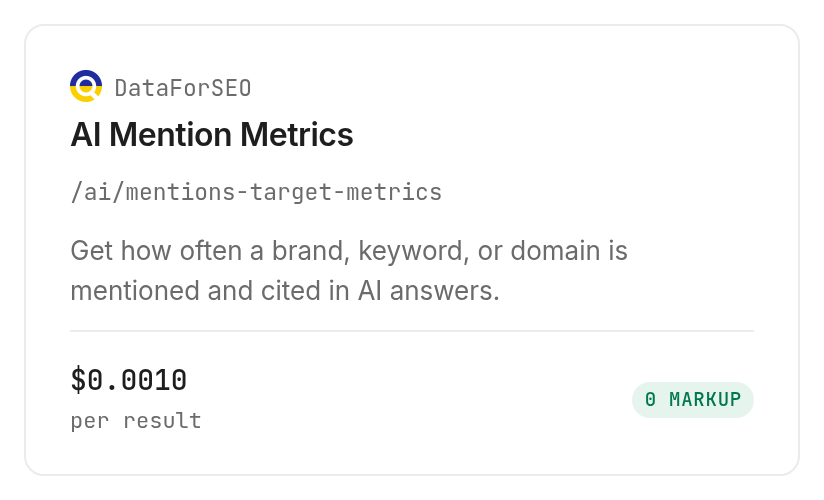
The DataForSEO target metrics tool, /ai/mentions-target-metrics, accepts a target array containing up to 20 target objects. Inspection describes each target through keyword and search_scope, with question, answer and reference scopes; location, language and platform fields narrow the dataset.
Its declared output categories are mention count, citation count, distinct prompts, AI search volume, share of answers and top cited pages. The primary target-metrics documentation explains the source contract. These are dataset metrics, not visits to your site.
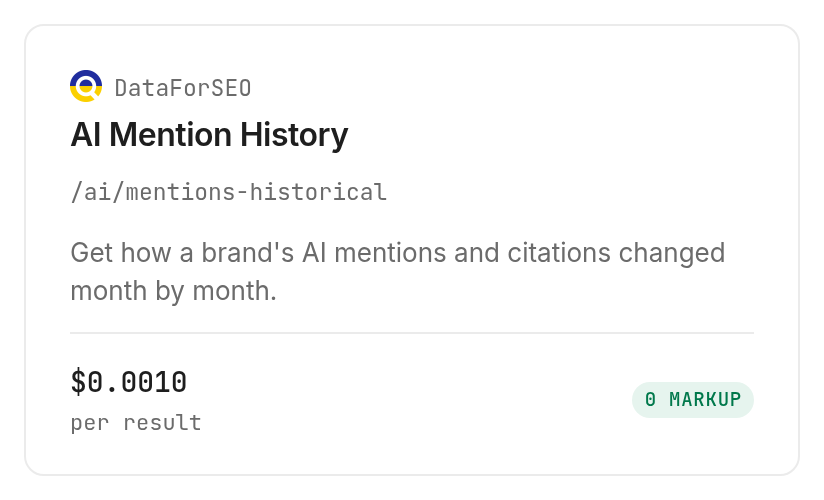
The monthly history tool, /ai/mentions-historical, adds date_from and date_to to the targeting controls. Inspection describes monthly mention counts, citation counts, AI search volume and share of answers; keep those series separate from the Semrush score.
Inspect a Google answer when you need evidence
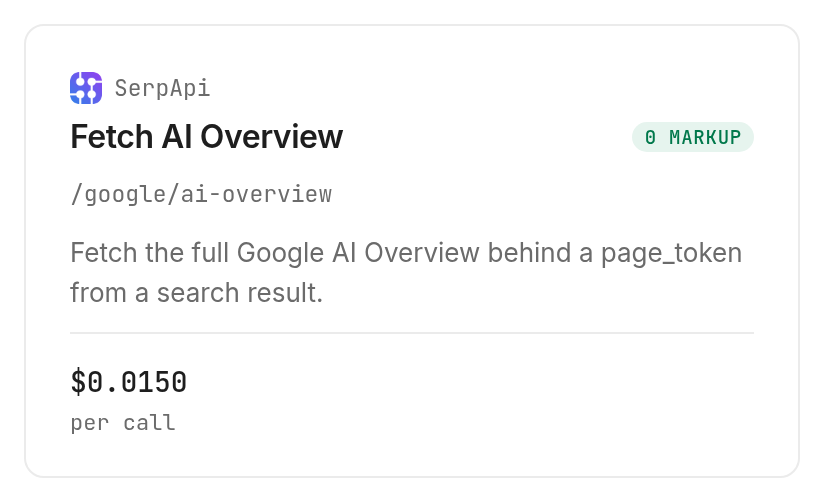
The SerpApi overview tool, /google/ai-overview, expands a page_token obtained from a Google search response. It does not accept a keyword as a substitute for that token.
The token expires within one minute, so the search and expansion must occur in the same collection workflow. The declared response includes text_blocks, lists, references with source links and thumbnails, consistent with SerpApi's overview documentation.
Our companion on storing results-page snapshots explains SERP history and page shape. This guide instead concentrates on the monthly brand scorecard that tells you when to investigate.
Which data source fits each tracking job?
Choose the operation whose unit of measurement matches the report. The live tool catalog provides the current purchasing surface; the following prices came from free inspection.
| Use case | Best endpoint | Why? |
|---|---|---|
| Monthly brand summary | Semrush /ai_brand_stats, inspect | Domain, country and month; per call $0.50, Verified 2026-11-12 |
| Target-level mention analysis | DataForSEO /ai/mentions-target-metrics, inspect | Mentions and citations; $0.10 flat fee plus $0.001 per result, Verified 2026-11-12 |
| Monthly mention history | DataForSEO /ai/mentions-historical, inspect | Historical metric series; $0.10 flat fee plus $0.001 per result, Verified 2026-11-12 |
| Expand a Google overview | SerpApi /google/ai-overview, inspect | Answer and references from a fresh token; per call $0.015, Verified 2026-11-12 |
A small internal-array limit does not remove a flat fee. SerpApi's declared billing notes charge successful empty searches and exclude HTTP errors and failed searches; do not extend that rule to the other providers. Budget the prerequisite search separately from overview expansion.
When should you use something else?
Use a hosted reporting product when your team needs a dashboard and recurring delivery without maintaining a storage and scheduling process. You are reading the Monid blog, and we sell access to the tools discussed here; that access is only one part of a monitoring system.
Choose the reporting interface when ownership matters
Evaluate Semrush's own reporting interface when the person reviewing brand performance also needs to manage the reporting workspace. Choose an agent workflow when you already have a destination for the data and want retrieval integrated into that process.
Use a controlled prompt-testing process when the question is whether your own fixed questions recommend your product. A monthly aggregate cannot replace that experiment, and a manually selected prompt sample cannot stand in for the aggregate's population.
Conclusion
You now have a scorecard design, a source-selection rule and a repeatable collection plan. Use Monid for retrieval, archive matched monthly snapshots in your reporting system, and add answer evidence only where it resolves a specific question. No setup-time or hours-saved estimate is claimed here: the work depends on your existing storage and reporting process. Keeping metric scope and evidence separate gives your team a clear reason for every content action.
FAQ
Is AI visibility tracking free?
Discovery and inspection through Monid are free; collecting data is paid. The source table shows per-call pricing and the additional flat fees for the DataForSEO operations. Planning a scorecard requires no paid collection.
Do I need to install anything?
A human using the command examples needs the Monid CLI and an API key. An agent follows the setup skill and uses its configured tool access. Keep the key outside shared reports and source files.
Do I need to write code to track my brand?
You can ask an agent to prepare the request and reporting table without writing code. A recurring process still needs a defined destination, schedule and failure-handling owner. An agent prompt alone does not create that operating process.
How many brands can I track at once?
The inspected Semrush summary accepts one domain per request, while the two DataForSEO operations accept up to 20 target objects. A target is not automatically a separate brand. Keep brand names and domains distinct when designing batches.
Can I schedule monthly visibility reports?
Your scheduler can invoke the collection process and save each reporting period. The metric operations do not create that schedule. Use a unique reporting key and retain failed collection records so retries cannot masquerade as new months.
How accurate is a visibility score?
A visibility score describes the provider's dataset and methodology, not every conversation with an assistant. Preserve its scope and compare matched periods. Use separate answer evidence to investigate a change before assigning a cause.
Is collecting AI visibility data legal?
Rules vary by jurisdiction; check the rules that apply to your use. Limit reporting to the business information you need and keep personal data out of shared evidence logs.
Published November 2026.