How to Use a Backlink API in Your SEO Agent
Get a small backlink sample into your agent, preserve its source fields, and export a review sheet with clear limits and billing.
Give your SEO agent a small backlink sample it can explain. Paste this into your agent:
Set up https://monid.ai/SKILL.md, and then use Monid to inspect Ahrefs backlink retrieval for example.com. Request only three rows in domain mode. Save the original response and build a review sheet with source ratings, anchor state, link type, dofollow and last-seen date. Keep review advice separate from returned facts.
A small sample first · min setup and hrs saved are not measured for this guide.
SEO developers searching for a backlink API need link records their agent can use. Copying a dashboard export into a chat leaves you maintaining two artifacts: the original data and the agent's interpretation. A three-row test is enough to check that handoff before expanding it.
A list of source URLs alone leaves important questions unanswered. Which target scope produced the list? When did the source last observe each link? Did the agent preserve an empty anchor or replace it with an invented label?
We'll use Monid, the OpenRouter for agent tools, to retrieve a bounded sample through one key and balance. You'll finish with original JSON and a review sheet that separates returned fields from your decisions. Choose the scope, retrieve three rows, then export the evidence.
Preview of the actual sample returned on October 31, 2026:
| Source domain | Source DR | Source UR | Link type | Anchor state |
|---|---|---|---|---|
| schaumburgtoyota.com | 8 | 18 | text | Empty |
| gazzetta.gr | 69 | 0 | image | Present |
| canva.com | 93 | 35 | text | Present |
The three returned rows are a sample, not a count of all backlinks to example.com. Every row had is_dofollow: true; that observation does not establish the proportion across the domain's entire link profile.
How to use a backlink API with Monid
Use Monid to discover the tool, inspect its input and billing, and request a small number of rows. An endpoint is the callable address for one tool operation; here we use Ahrefs backlink retrieval to get individual links.
For agents
Get a key at app.monid.ai, give it to your agent through your usual secret handling, and paste:
set up https://monid.ai/SKILL.md
The agent quickstart explains the setup workflow.
For humans
Install the CLI and add your key:
npm install -g @monid-ai/cli
monid keys add -k <your-api-key> -l main
Keep credentials outside the exported response and any repository you share.
Step 1. Discover the available link tools
Search the catalog before choosing a provider; the extra flag includes tools currently marked unavailable so you can reject them explicitly.
monid discover -q "backlink api" -l 15 --include-unavailable -j
Step 2. Inspect the scope and price
Read the schema before paying: the tested Ahrefs operation takes query parameters, so its input belongs in --query.
monid inspect -p ahrefs -e /site-explorer/all-backlinks -j
Choose mode: "domain" for the domain without subdomains; use exact for one URL, prefix for URLs starting with a target, or subdomains for the domain and its subdomains.
Step 3. Retrieve three links
Set a small limit when testing: three rows let you examine the response without requesting the default 100.
monid run -p ahrefs -e /site-explorer/all-backlinks \
  --query '{"target":"example.com","mode":"domain","limit":3}' -w -j
Our call returned three records, reported HTTP 200, and completed in 21.525 seconds between its recorded creation and completion timestamps.
Step 4. Preserve the original response
Retrieve the completed response by its actual identifier and save it before asking an agent to summarize it.
monid runs get -r 01M69BCYW6R7GFDJZVSBWG4PMF -o backlinks.json
For your own request, use its returned identifier; preserve target, mode, retrieval date and provider beside the file so someone else can reconstruct the report's scope.
Why preserve the source before judging a link?
Preserve source fields because a backlink record describes an observation, while a review decision describes what you intend to do next. Mixing them makes the agent's advice look like provider data.
Keep observation dates attached
The sample contained last-seen dates in 2021, 2024 and 2026. Those dates belong beside the corresponding records; a successful request today does not mean every source page was observed today.
Use the returned dates to order a review queue. Our editorial rule is to examine older observations before treating them as current evidence of a placement. The record alone does not show what a browser would find at that URL now.
Separate a sample from a total
Three rows cannot answer how many referring domains a target has. A row limit controls the retrieved slice, and the default order does not establish that the first slice is representative.
For profile-level reporting, the guide to backlink totals, referring domains and anchors explains those separate reports. This guide stays with ingestion: preserving individual source and destination records so later analysis remains traceable.
Keep provider ratings with their original field names. A source domain's rating and a source page's rating are distinct columns, and neither value in this sample measures traffic generated by that link.
The 3 ways to feed backlinks into an agent
Choose the input route around the artifact you need: a one-off file, repeated individual link records, or a different provider's inspected data contract. The retrieval route does not replace your review logic.
| Route | Billing shape | Best fit | Limitation |
|---|---|---|---|
| Monid with Ahrefs | Per returned row | Repeatable agent retrieval | A limited sample is not a complete inventory |
| Existing export | Existing access arrangement | A file you already hold | Refreshing it is a separate task |
| Monid with DataForSEO | Flat fee plus returned rows | Evaluating another input contract | Different billing and parameter names |
Use a file you already have
Keep your existing export when you only need to explain that file once. Add its download date and target scope, then ask the agent to describe only the columns present.
For a manual check before automation, the free backlink checking guide helps choose that first step. Free inspection of a tool and free retrieval of backlink data are different things.
Use the tested individual-link route
Monid gives your agent the same discover, inspect and retrieve sequence on each occasion. With the tested Ahrefs tool, keep the three-row request until your parser and export preserve every required field.
Only raise the limit after deciding which rows the downstream review needs. A larger sample that nobody examines creates a larger bill and a larger unfinished queue.
Inspect another provider before switching
DataForSEO backlink retrieval uses a JSON body, including target and limit, rather than this example's query object. Its schema allows a maximum of 1,000 rows and declares continuation through search_after_token.
monid inspect -p dataforseo -e /backlinks/backlinks -j
This route is inspect-only here because its billing combines a flat fee with returned rows. The inspected schema is useful for comparing input requirements; it is not evidence that this guide retrieved a DataForSEO dataset.
How to read and export the three returned links
Read the sample as three individual observations and add your next action in a separate column. The following table keeps returned facts distinct from editorial review advice.
| Source domain | Dofollow | Last seen date | Editorial next action |
|---|---|---|---|
| schaumburgtoyota.com | true | 2024-06-25 | Review the page and empty anchor in context |
| gazzetta.gr | true | 2021-02-25 | Review the image placement and older observation |
| canva.com | true | 2026-10-15 | Review the destination and surrounding text |
Keep empty values and link types
An empty anchor is data: preserve the empty string and derive an anchor_state label separately. In the sample, an image link had nonempty anchor text, so link type and anchor presence belong in separate columns.
Do not use the dofollow flag as an automatic approval label. It is one returned attribute; context and the relevance of the source page require a separate review.
The raw output also returned url_from, url_to, title, first_seen, domain_rating_source and url_rating_source. Keep these fields in your saved artifact even when the review table displays fewer columns.
Export only the columns your reviewer needs
If you use jq, this local transformation illustrates an export of returned fields after saving the CLI's JSON envelope:
jq -r '
  ["url_from","url_to","domain_rating_source","url_rating_source",
   "is_dofollow","link_type","first_seen","last_seen"],
  (.output.rows[] | [.url_from,.url_to,.domain_rating_source,
   .url_rating_source,.is_dofollow,.link_type,.first_seen,.last_seen])
  | @csv
' backlinks.json > backlinks.csv
Keep the original JSON beside the CSV. Treat spreadsheet cells as data when opening an export, and add review notes in new columns rather than editing provider fields in place.
For repeated checks, compare records using the source URL and destination URL together. A changed anchor is then a change to an observed link, rather than an unrelated new row created by your spreadsheet layout.
How much does a small backlink check cost?
The tested Ahrefs backlink tool costs $0.00645 per returned row, Verified 2026-10-31. The successful three-row request reported a total charge of $0.01935, Verified 2026-10-31, matching three billed units.
Discovery and inspection through Monid are free. The charge begins with paid retrieval; use the monid.ai/tools to choose the operation before authorizing it.
The Ahrefs inspection states that there is no request minimum and an empty result is free. Our successful sample had three results, so that billing record establishes the three-row charge only. Keep errors separate from valid empty responses in your application.
Read the entire billing shape
The inspected DataForSEO route lists $0.000036 per result plus a $0.024 flat fee, Verified 2026-10-31. A per-result amount without its flat fee is an incomplete budget.
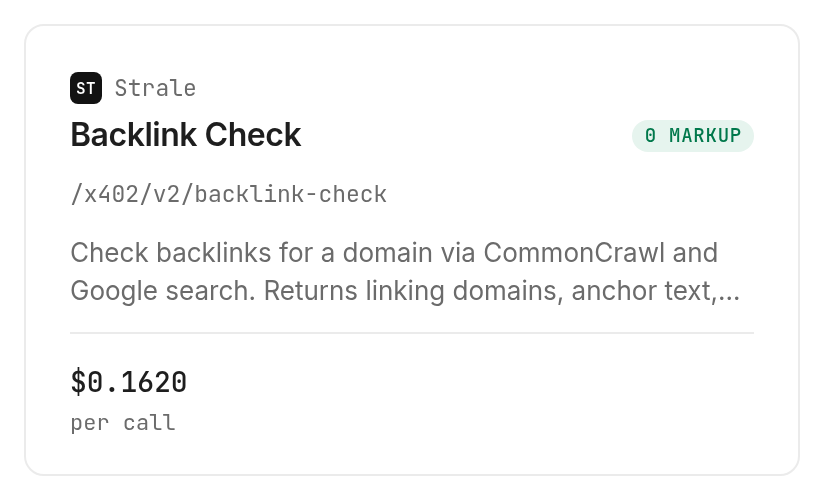
Two inspected Strale variants each list a per-call price above this guide's testing threshold. The original Strale checker costs $0.162 per call, Verified 2026-10-31; we inspected its required domain query input without making a paid request.
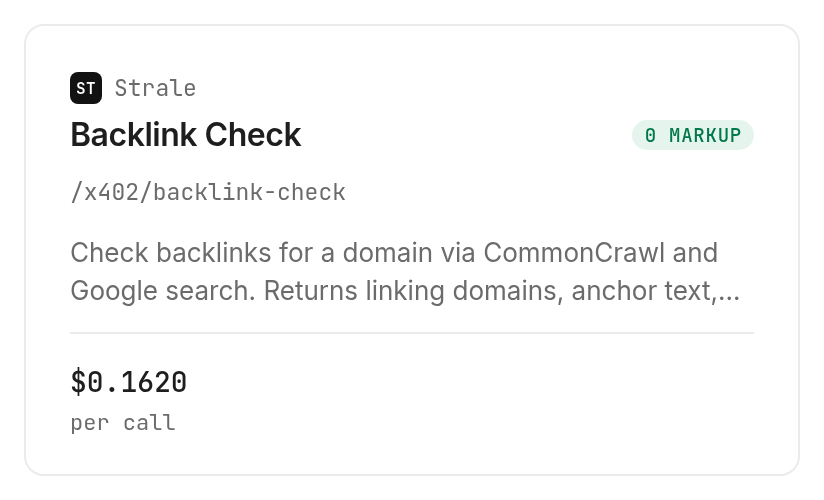
The versioned Strale checker costs $0.162 per call, Verified 2026-10-31. Inspection exposes the same required domain input; its description names linking domains, anchor text and dofollow/nofollow counts, without a declared response object schema.
When should you use something else?
Use a browser when the decision depends on what a source page contains now. The sample includes historical observation dates, and retrieval does not perform a present-day page review for you.
Use an existing Ahrefs export when your task starts and ends with that file. This is the Monid blog, and we resell access to these tools; adding a paid retrieval step to a file you already possess does not improve its contents.
Use your own analytics when the question is traffic or conversions. None of the returned fields attributes a visit, a sale or a ranking movement to a particular link.
The practical boundary is explicit: Monid retrieves indexed link records for your agent. It does not establish comprehensive web coverage, verify today's source-page content, or decide whether a link caused a business outcome.
Which endpoint should you use for which job?
Choose the SEO tool by its input contract and billing shape, then keep provider-specific fields intact in your storage.
| Use case | Best endpoint | Why? |
|---|---|---|
| Retrieve the sample used here | Ahrefs /site-explorer/all-backlinks | Tested individual links with ratings and dates; Verified 2026-10-31, per row $0.00645 |
| Evaluate body input and continuation | DataForSEO /backlinks/backlinks, inspect only | Inspect its schema first; Verified 2026-10-31, flat fee $0.024 plus per result $0.000036 |
| Inspect a domain checker | Strale /x402/backlink-check, inspect only | Required domain query input; Verified 2026-10-31, per call $0.162 |
| Inspect the versioned checker | Strale /x402/v2/backlink-check, inspect only | Inspect the described output before choosing; Verified 2026-10-31, per call $0.162 |
Conclusion
You now have a repeatable way to retrieve a bounded backlink sample through Monid, keep the original evidence, and turn returned fields into a review sheet. Three records demonstrated the handoff; the scope, dates and separate editorial column keep the sheet useful without presenting it as a complete inventory. Setup time and hours saved were not measured, so this guide makes no time-saving estimate. Your next review can start from traceable observations instead of a pasted list with its context missing.
FAQ
Is there a free backlink API?
Discovery and inspection are free through Monid; the tested backlink retrieval bills per returned row. Start in the current tools catalog and distinguish free tool selection from paid data.
What do I need to install?
For the command examples, install the Monid CLI with npm and add your API key. An agent can follow the setup skill instead. The optional CSV transformation uses jq locally.
Can I use a backlink checker API without writing code?
Yes, an agent can discover, inspect and call the tool from a natural-language instruction. Specify the target, scope and row limit, and ask it to keep provider facts separate from review suggestions.
How many backlinks can I request at once?
The inspected Ahrefs operation accepts 1 to 100 rows per request. This guide requested three. A request limit describes the retrieved slice and does not state the total size of the target's backlink profile.
Does an empty backlink result cost money?
The Ahrefs inspection states that an empty result is free because it has no per-request minimum. An input error is a different outcome; store its status separately and do not interpret it as evidence that the target has no links.
Can I schedule a backlink check?
Yes, schedule your script with your own job scheduler and preserve a dated response for each check. Keep the target scope and selection rules consistent so a change in configuration does not become a false change in the report.
Does a backlink API prove that a link is still present?
A returned record supplies the provider's observation fields, including the last-seen date in this sample. Open the source page when today's presence matters. A current retrieval timestamp does not replace the observation timestamp.
Published October 2026.