How to Use a Zillow Mortgage Estimate for a Home
Build a home payment scenario from a Zillow mortgage rate, a home value and your own housing costs.
Build a home payment scenario from a price and a mortgage rate. Paste this into your agent:
Set up https://monid.ai/SKILL.md, find Zillow mortgage rates, and help me build a monthly home payment scenario using my own price, down payment, taxes and insurance. Keep assumptions separate from retrieved data.
One prompt starts the research · Inspect the data before using it.
A homebuyer searching for a mortgage estimate zillow often starts with a listing price and a monthly payment box. That number changes when the down payment, loan term or interest rate changes, and it is easy to mistake principal and interest for the whole cost of living in the home.
Copying a single estimate into a budget hides those assumptions. A home value estimate is also a different number from a mortgage payment, and a rent estimate answers a different question again.
This guide helps you build a scenario with separate inputs and a clearly labelled total. Monid is a tool layer for agents that can retrieve Zillow mortgage rates and a home value estimate; you supply the purchase and household assumptions and calculate the payment. We will separate the figures, show the available data, and compare routes for making a decision.
Your finished worksheet has a home price, down payment, loan amount, term, interest rate, principal and interest, tax, insurance and other monthly costs. The illustration below explains the calculation; it is not a live result or a lender quote.
What does a mortgage estimate from Zillow include?
A mortgage estimate is a scenario for financing a home, while a Zestimate is an estimate of the home's market value. Keep those two concepts in separate columns before comparing anything else.
Price, down payment and loan balance
The purchase price is the amount assumed for the transaction. Subtract the down payment from it to get the initial loan amount for a simple scenario. A Zestimate can be a reference point when choosing a scenario price, but it is not the agreed purchase price and does not establish the loan amount on its own.
For example, a hypothetical home price of 400,000 dollars and an 80,000 dollar down payment produce a 320,000 dollar starting loan balance, before any financed costs. These are illustrative inputs, not Zillow data. Use the price and cash contribution you actually intend to test, and keep a record of each assumption alongside the result.
Interest, principal and the rest of the payment
Principal and interest are only part of the household budget. The Consumer Financial Protection Bureau explains that taxes, homeowners insurance and mortgage insurance, when applicable, can also appear in a monthly mortgage payment. Association fees and other housing costs can be paid separately, so include them in the household total even when they are not part of the lender payment.
Interest rate and APR are distinct. Use the interest rate for the principal and interest calculation; use APR as an additional comparison of borrowing cost, alongside fees and points. Do not insert APR as the payment rate simply because it appears beside the interest rate.
How to use a Zillow mortgage estimate for a home
Collect the rate and home value as references, then make your own payment scenario with explicit assumptions. Monid supplies the data retrieval step; its inspected endpoints do not calculate your complete monthly payment, verify your eligibility, or supply your individual loan offer.
Step 1. Choose the home and your assumptions
Get an API key at app.monid.ai if an agent will retrieve the data. Write down the intended purchase price, cash down payment, loan term and estimated monthly taxes, insurance and association dues. Keep the property address or Zillow property ID separately. Decide whether the scenario is for a purchase, refinance or a comparison, because an assumed purchase price is not automatically the balance of an existing loan.
Record the date next to each input. A rate collected today and an older property estimate answer different questions; the date makes it possible to revisit the calculation without losing its context. For a home that has not been chosen, start with a budget range instead of treating one listing as your entire search.
Step 2. Find the mortgage rate data
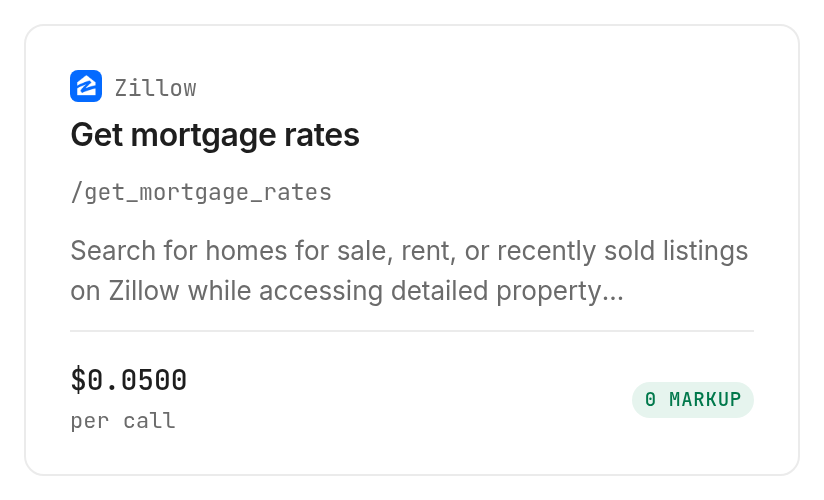
The Zillow tool page lists zillow /get_mortgage_rates. Its inspected description says it returns interest rates, APR and associated fees or points for loan types including fixed, FHA, VA, jumbo and adjustable-rate mortgages. The description says rates update daily. It has no declared query properties, so there is no documented borrower or property input in the inspected schema.
The listed price is $0.05 per call, Verified 2026-11-18. Discovery and inspection are free; a run is the paid step. Browse the catalog at monid.ai/tools. This guide uses the inspected description and does not report a live rate or a tested response. The inspection did not specify how failed or empty calls are billed.
Step 3. Add the property estimate when it helps
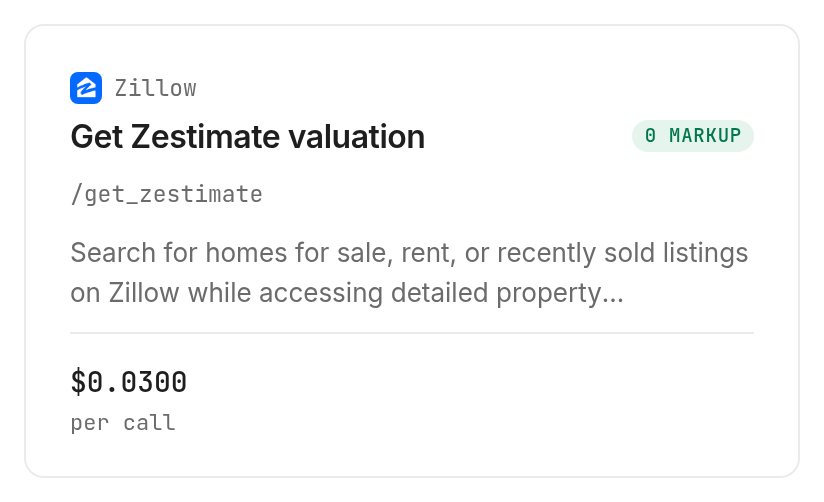
The property data tool page also lists zillow /get_zestimate, which takes a numeric Zillow property ID as a required zpid query parameter. Its description says it retrieves a Zestimate and rent Zestimate for that property. The endpoint is for a property estimate, not a complete payment calculation.
The listed price is $0.03 per call, Verified 2026-11-18. This guide describes the inspected endpoint without running it. A property ID identifies the home; it does not tell the service your down payment, insurance or lender offer.
Step 4. Build and save the scenario
Put the rate, term and loan balance into a fixed-rate mortgage calculator, then add your own estimated recurring costs. Save the input assumptions with the result, including whether an item is included in the lender payment or paid separately. The CFPB's payment explanation describes how loan amount, term and interest rate determine principal and interest.
For a fixed rate, a spreadsheet can use =PMT(annual_rate/12, years*12, -loan_amount) for monthly principal and interest. Enter the annual rate as a percentage, not as a whole number. This formula does not model a changing rate, closing costs or a payment holiday; use terms appropriate to the loan you are evaluating.
How do Zillow home value estimates affect your loan?
A Zillow home value estimate can help frame a purchase scenario, but it does not replace an appraisal or decide the amount a lender will finance. Zillow describes the Zestimate as a model-based market value estimate and explicitly says it is not an appraisal.
Read a Zestimate as a starting point
A home value Zillow estimate reflects available property and market information rather than an inspection of your particular transaction. A buyer can compare the estimate with the listing price and recent comparable sales, then investigate why the figures differ. Look at the property facts first: a missing renovation, a different bedroom count or a stale feature description changes the context for interpreting a model estimate.
Our guide to checking a Zestimate before comparing homes covers how to investigate the number in more detail. For another reference, the Chase mortgage home value estimator guide explains a separate valuation workflow. Neither estimate is a guarantee of the eventual sale price.
Keep value and financing in separate columns
A Zillow estimate value of home and a mortgage balance can move independently. If you change the assumed home price but hold the down payment in dollars constant, the loan balance changes. If you instead hold the down payment percentage constant, both the cash contribution and the loan balance change. Label which assumption you used so that two scenarios remain comparable.
For a Zillow homes values estimate, use one property and one observation date per row. Record the source, estimate and your chosen scenario price separately. This makes a discrepancy visible instead of silently converting the estimate into a firm offer. A lender's appraisal and underwriting process answer a separate financing question.
How do Zillow rental estimates fit the comparison?
A rent Zestimate is an estimated rental value, not a mortgage estimate or a statement of a tenant's actual rent. It belongs in a separate rent-versus-buy worksheet, where the costs and time horizon are explicit.
Compare monthly costs on the same basis
For a Zillow rental estimate, list estimated rent and any tenant-paid utilities or fees on the rental side. On the ownership side, list principal and interest, taxes, insurance, association dues and an allowance for maintenance. Note which items are included in rent and which are paid separately. The comparison is a budget exercise, not a forecast of investment returns.
A rental estimate on Zillow does not tell you the terms offered by a landlord or the available inventory for a particular move date. Ask for the actual lease terms before using a rental figure as a commitment. Likewise, the rent Zestimate is not a payment that a homeowner receives after expenses; vacancies and property costs belong in a separate rental-property analysis.
Separate rent and home price estimates
A Zillow rent estimate and a Zillow home prices estimate describe different measures and use different units: monthly rent versus estimated property value. Put the unit in the column heading. If you combine them to calculate an annual rent-to-value ratio, label the result as your own calculation and state that it omits expenses, financing and vacancies.
The Zillow property agent guide explains how property data can enter an agent workflow. For a single household decision, a short worksheet with the actual lease and purchase assumptions is easier to audit than an unexplained score.
How do you compare mortgage scenarios?
Change one assumption at a time and keep the remaining inputs fixed. This shows what causes a payment difference instead of presenting several unrelated totals as if they were equivalent.
Build a worksheet that can be checked
| Column | What to record | Why it matters |
|---|---|---|
| Home price | Your assumed purchase price | Sets the starting point for the balance. |
| Down payment | Cash amount and percentage | Shows both cash needed and the amount financed. |
| Loan amount | Price minus down payment, plus any financed costs | Determines the balance used in the payment formula. |
| Loan terms | Term and interest rate | Controls the principal and interest calculation. |
| Other costs | Taxes, insurance, dues and applicable mortgage insurance | Makes the household total more complete. |
| Source and date | Rate source, value source and retrieval date | Makes the scenario reproducible. |
This table is a worksheet design, not a returned dataset. No live response values are shown here. If a field is absent from a data source, leave it blank and obtain the assumption from the appropriate document or person rather than filling the gap with an invented value.
Test the decision, not just the formula
Compare a smaller and larger down payment while keeping the same price, rate and term. Then compare a different rate while holding the loan amount fixed. For each row, keep the cash required at the start visible alongside the monthly cost: lowering the loan balance requires more cash in the simple example, so the lowest payment does not tell the whole story.
Use the lender's written Loan Estimate when you have one. Its projected payments and closing costs describe that lender's offer, while a general rate feed is a research input. A mortgage calculator is useful for exploring assumptions before an offer; it cannot decide whether a payment is comfortable for your household.
Which data source fits each job?
Use the source that answers the question in that column, then calculate the household total separately. The inspected Monid descriptions identify the following data, without promising a particular live response structure.
| Use case | Best endpoint | Why? |
|---|---|---|
| Compare published mortgage rate categories | zillow /get_mortgage_rates | Inspect describes rates, APR and associated fees or points; $0.05 per call, Verified 2026-11-18. |
| Reference a property's home and rent estimate | zillow /get_zestimate | Inspect describes both estimates for a supplied property ID; $0.03 per call, Verified 2026-11-18. |
What the descriptions do and do not establish
The descriptions identify the data categories, but inspect did not supply a response JSON schema or a sample output. They do not establish exact field names, missing-value behavior or a particular rate. Save the response from your own call and inspect its shape before building a parser. Neither endpoint supplies the full scenario table in this guide.
When should you use something else?
Use Zillow's interactive calculator when you want to adjust a single scenario on screen, and use a lender's Loan Estimate when you need an offer tied to your application. You are reading the Monid blog, and Monid offers access to these data tools; the general rate feed does not replace a lender's underwriting or a personalized offer.
Choose the right depth for the decision
If the only question is whether one home fits a monthly budget, a calculator plus your actual expense assumptions is enough to start. An agent workflow earns its place when you need to collect the same categories repeatedly and keep assumptions attached to each comparison. A qualified appraiser, lender or housing counselor addresses questions that a property estimate or a general rate feed cannot settle.
Conclusion
You now have a repeatable worksheet that separates the home value, loan assumptions, rate and other housing costs. Retrieve fresh data when needed, preserve its date, and compare the result with a lender's written terms so you can judge a home against your own budget.
FAQ
How accurate is a Zillow Zestimate?
A Zestimate is an estimate, not an appraisal. Zillow publishes accuracy information and explains that accuracy varies by property and location; compare the property facts and relevant sales before relying on a single number.
How do I find the Zestimate on my home?
Find the property on Zillow and use its Zestimate as a starting point for a home value comparison. For an agent workflow, the inspected property estimate tool takes the property's numeric Zillow ID.
Is a Zillow rent Zestimate the same as a mortgage payment?
No. A rent Zestimate estimates rental value, while a mortgage payment depends on a loan balance, rate and term as well as applicable taxes and insurance.
Does a Zillow estimate of home value set my purchase price?
No. A home value estimate is a reference; the price in your scenario should be the amount you intend to offer or evaluate, and the final transaction price is agreed by the parties.
Can I get Zillow mortgage rates without writing code?
Yes. An agent can use the Monid tool workflow after you provide access, and an interactive calculator is another route for a single scenario. You still supply your own household assumptions.
Is the mortgage rate data free to retrieve?
Discovery and inspection are free, and the mortgage rate call is $0.05 per call, Verified 2026-11-18. See the current Zillow listing for the current price.
Can I use the same mortgage estimate for every home?
No. Recalculate for each assumed purchase price, down payment and applicable property costs, and record the rate and term used in each scenario.
Published November 2026.